Long Tail Keyword Research
Find low-competition long-tail keyword phrases & questions
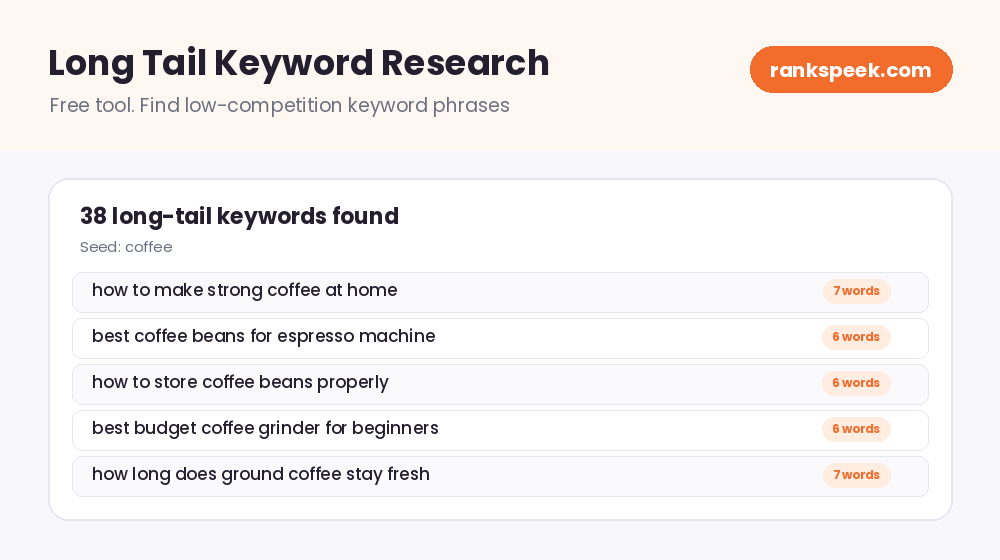
Free Long Tail Keyword Research Tool. Find Easy Keywords That Rank
A free long tail keyword research tool helps you discover longer, more specific search phrases that are easier to rank for than broad keywords. Instead of fighting for a huge term like "coffee", you can target a phrase like "how to make strong coffee at home". These long tail keywords bring visitors with clear intent, and they are the smartest starting point for new websites and blogs. With our free tool, you enter one seed keyword and get a full list of long tail ideas in seconds.
A long tail keyword is a longer, more specific search phrase, usually made of three or more words, such as "best running shoes for flat feet". Long tail keywords have lower search volume than broad terms, but they are much easier to rank for and attract visitors who know exactly what they want. That makes them ideal for new websites, blogs, and niche sites.
What Is a Long Tail Keyword Research Tool?
A long tail keyword research tool takes one starting word, called a seed keyword, and expands it into a long list of specific phrases people actually search for. You type in a broad topic, and the tool returns dozens or hundreds of longer variations. This saves you hours of guessing and manual searching. Instead of wondering what your audience types into Google, you see it directly and can pick the phrases that fit your content plan.
Seed Keyword vs Long Tail Keyword
The difference is simple. A seed keyword is your broad starting point, like "coffee" or "running shoes". A long tail keyword is a specific phrase that grows from that topic, like "how to store coffee beans at home" or "best running shoes for beginners".
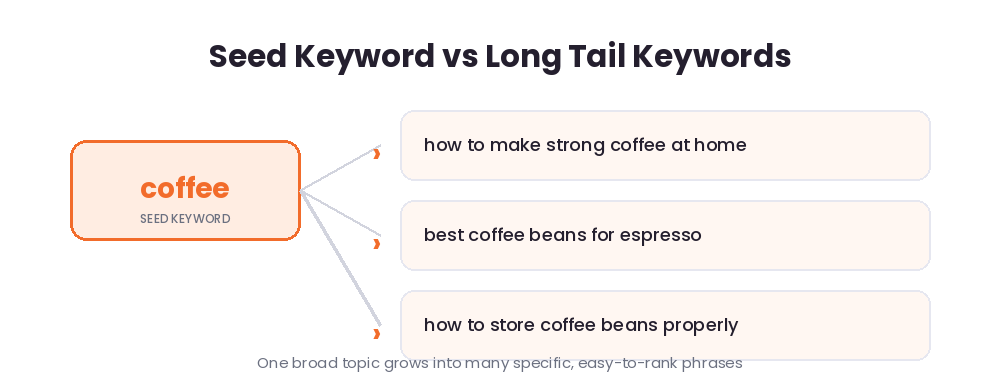
Seed keywords help you find the topic. Long tail keywords help you target exactly what a searcher wants. Good keyword research starts broad and then narrows down to the specific phrases worth writing about.
Why Long Tail Keywords Are Easier to Rank
Broad keywords are dominated by big, established websites with strong authority. Competing with them as a small or new site is nearly impossible. Long tail keywords change the game:
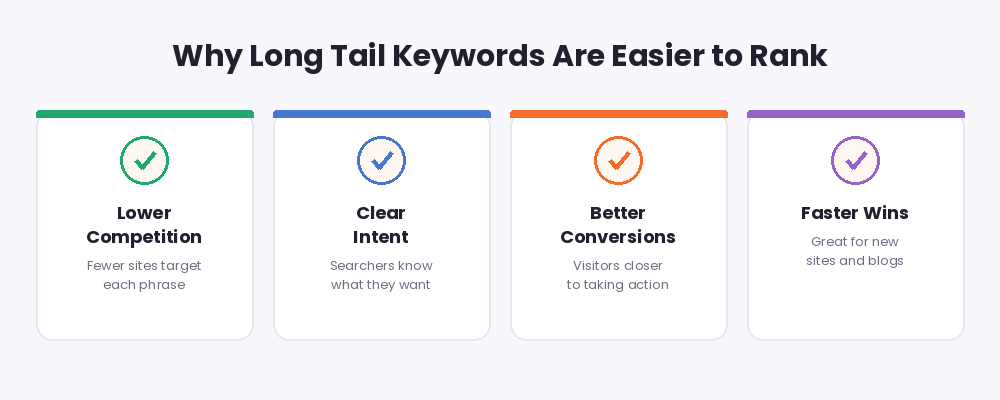
- Lower competition. Fewer sites target each specific phrase, so page one is within reach.
- Clearer intent. Someone searching "best budget gaming laptop under 500" knows what they want. Matching that intent is easier.
- Better conversions. Specific searches bring visitors who are closer to taking action.
- Faster wins for new sites. Ranking for many small phrases builds traffic and authority step by step.
- They add up. Individually small, but dozens of long tail pages together can bring serious traffic.
How to Use the Free Long Tail Keyword Research Tool
You need no experience at all:
- Step 1. Enter a seed keyword. Type one broad word or phrase about your topic in the box above.
- Step 2. Run the search. Click the button and the tool generates long tail suggestions.
- Step 3. Scan the list. Look for phrases that match your topic and audience.
- Step 4. Pick and write. Choose the most relevant phrases and build helpful content around them.
How to Choose the Best Long Tail Keywords
Not every suggestion deserves an article. Use these checks to shortlist winners:
- Relevance first. The phrase must genuinely match what your site is about.
- Clear intent. Ask what the searcher wants: information, a comparison, or a purchase. Match your content to that.
- Realistic competition. Search the phrase in Google and look at page one. If it is full of huge brands, pick a more specific variation.
- One topic per page. Give each strong long tail keyword its own focused article instead of stuffing many into one.
- Question phrases are gold. Searches starting with "how", "what", "why", and "best" often make perfect article titles.
Long Tail Keywords in 2026
Long tail keywords matter even more in 2026. As Google shows AI-generated overviews for many broad searches, generic terms send fewer clicks to websites. Specific long tail searches still bring engaged visitors, because detailed questions need detailed answers. Search engines also understand topics and context better than ever, so a helpful article targeting one clear long tail phrase can rank quickly and earn a place in AI summaries too. The winning strategy is simple: cover specific questions thoroughly, one page at a time.
Tips for Getting the Most From Long Tail Research
- Start with several different seed keywords to explore your niche from every angle.
- Group related long tail phrases into content clusters around one main topic.
- Use question keywords for FAQ sections and blog titles.
- Check your competitors' content for long tail topics you have not covered yet.
- Revisit the tool regularly, because new search phrases appear all the time.
Related Free SEO Tools on RanksPeek
Use these other free tools to research and refine your keywords. Just click any button to open it:
Helpful resource: To learn how Google understands search queries, read the Google Search Central documentation →
Frequently Asked Questions
What is a long tail keyword?
A long tail keyword is a longer, more specific search phrase, usually three or more words, such as "best laptop for video editing". These phrases have less competition and clearer intent than broad terms.
Why are they called long tail keywords?
The name comes from the shape of the search demand curve. A few broad terms get huge volume, while millions of specific phrases each get small volume. Those specific phrases form the long "tail" of the curve.
Are long tail keywords better for new websites?
Yes. New sites lack the authority to compete for broad terms. Long tail keywords offer realistic ranking opportunities and help build traffic and trust over time.
How many words make a keyword long tail?
There is no strict rule, but phrases of three or more words are generally considered long tail. What matters most is that the phrase is specific and has clear intent.
Do long tail keywords have enough search volume?
Individually their volume is small, but that is the point. They are easier to rank for, and many long tail pages together can bring more total traffic than one impossible broad term.
Enter a seed keyword above and uncover the specific phrases your audience is already searching for.
From our Blog
 AI Schema Markup Generator: How to Use It SafelyAn AI Schema Markup Generator takes a page you already have and writes the structured data code for it, so sea…
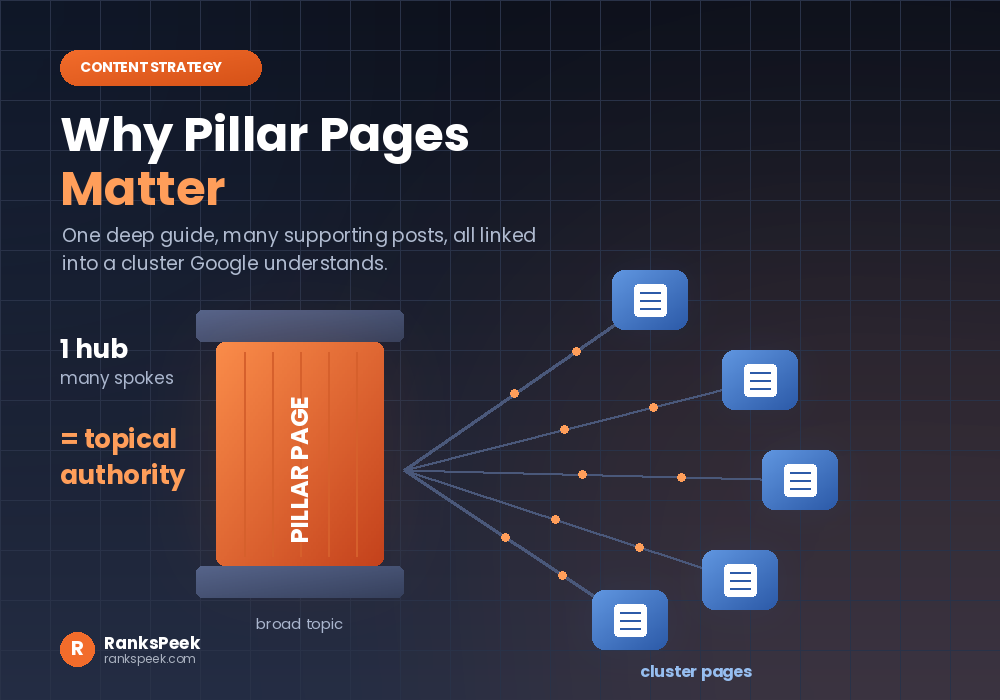 Why Pillar Pages Matter: The SEO Case for Topic ClustersWhy Pillar Pages Matter comes down to one idea: Google rewards depth, and a pillar page is how you prove it. A…
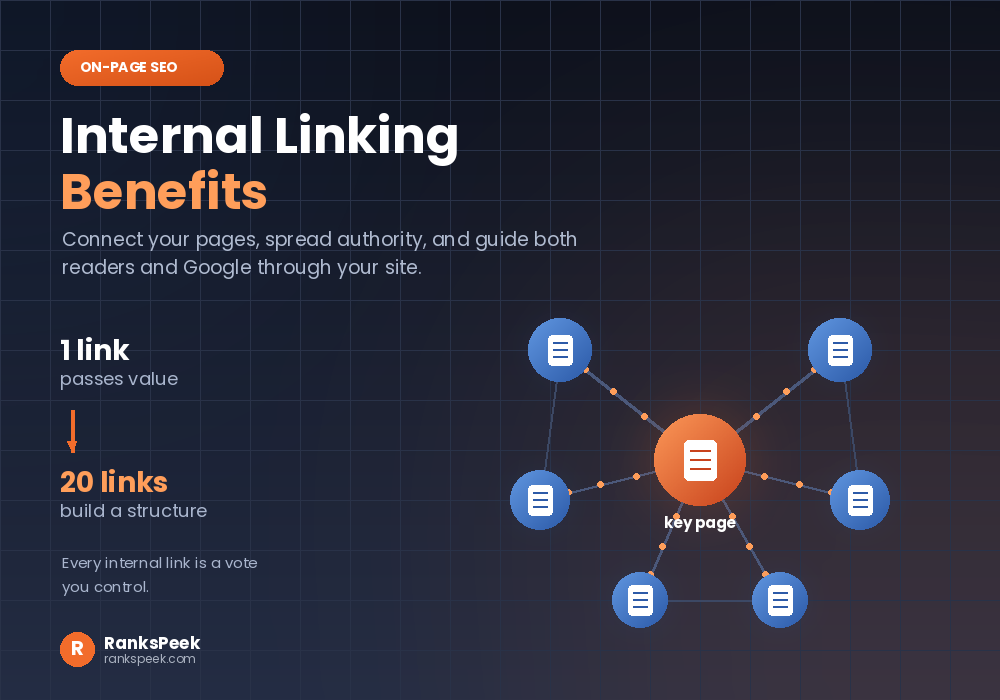 Internal Linking Benefits: Why They Matter for SEOInternal Linking Benefits are some of the easiest wins in all of SEO, because they cost nothing and you contro…