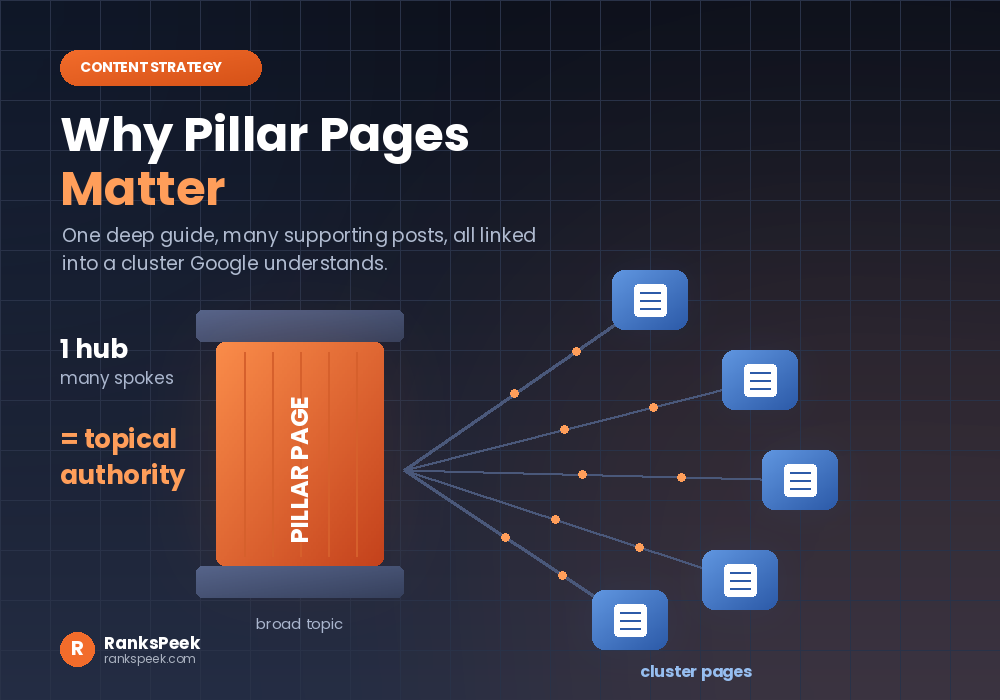
Why Pillar Pages Matter comes down to one idea: Google rewards depth, and a pillar page is how you prove it. A pillar page is a single, thorough guide to a broad topic, linked to a set of smaller posts that each cover one piece of it in detail. Together they form a topic cluster. So instead of publishing scattered articles that fight alone, you build a connected structure that lifts every page inside it.
Quick answer: Why Pillar Pages Matter is simple. A pillar page covers a broad topic in full and links to smaller cluster pages that each go deep on one subtopic. That structure helps Google crawl your site, proves topical authority, targets broad and long tail keywords at once, and keeps readers on your site longer. In short, structure beats scattered posting.
What Is a Pillar Page, and Why Pillar Pages Matter
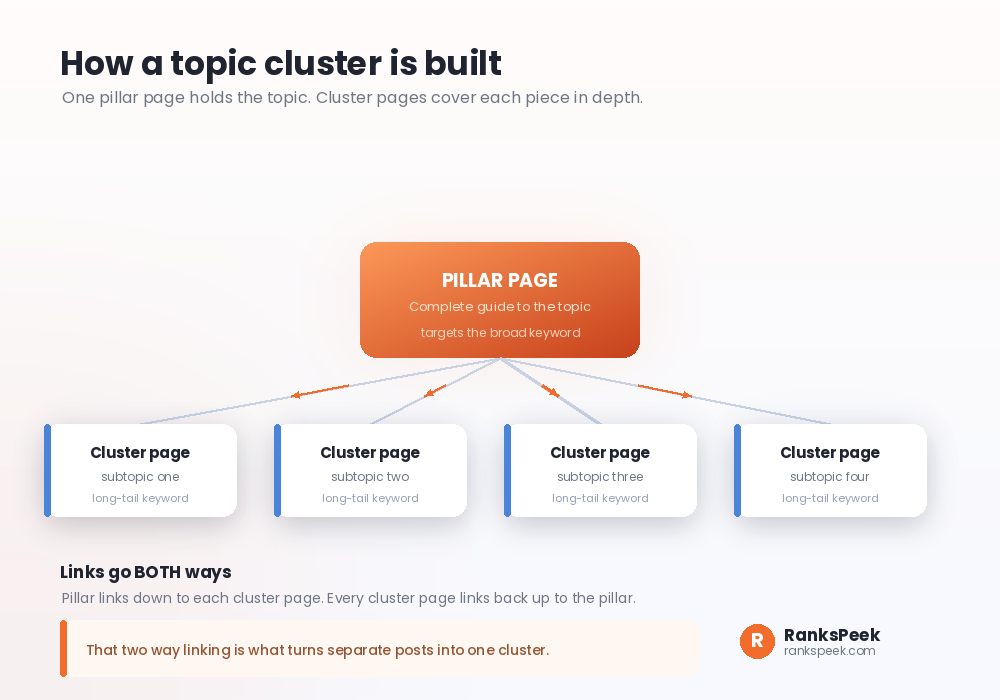
A pillar page is one comprehensive guide to a broad subject. It gives a full overview, then links out to more detailed posts that cover each subtopic properly. Those smaller posts are called cluster pages, and each one links back to the pillar.
That structure is the short answer to why pillar pages matter. Think of it as a hub and its spokes. Firstly, the hub explains the whole topic so a newcomer can follow it. Secondly, each spoke answers a narrower question in depth. Consequently, a reader can start anywhere and still find their way around.
The pillar targets the broad keyword. Meanwhile, each cluster page targets a longer, more specific phrase. So you cover the whole search demand for a topic instead of chasing one term at a time.
Why Pillar Pages Matter: The Topic Cluster
Ask why pillar pages matter and most people point at the page itself. Actually, the cluster is the magic, not the page alone. A pillar with no supporting posts is just a long article, and a group of posts with no hub is just a pile of content.
The connection is what search engines read. When your pillar links down to each cluster page, and every cluster page links back up, you draw a clear map of how your content fits together. Therefore Google can see that you cover the subject properly, not just once by accident.
That two way linking is the part people skip. However, it is exactly what turns separate posts into a working cluster, and it costs nothing but attention. Our guide on internal linking benefits explains the mechanics behind those links in more detail.
Why Pillar Pages Matter: Six Real Reasons
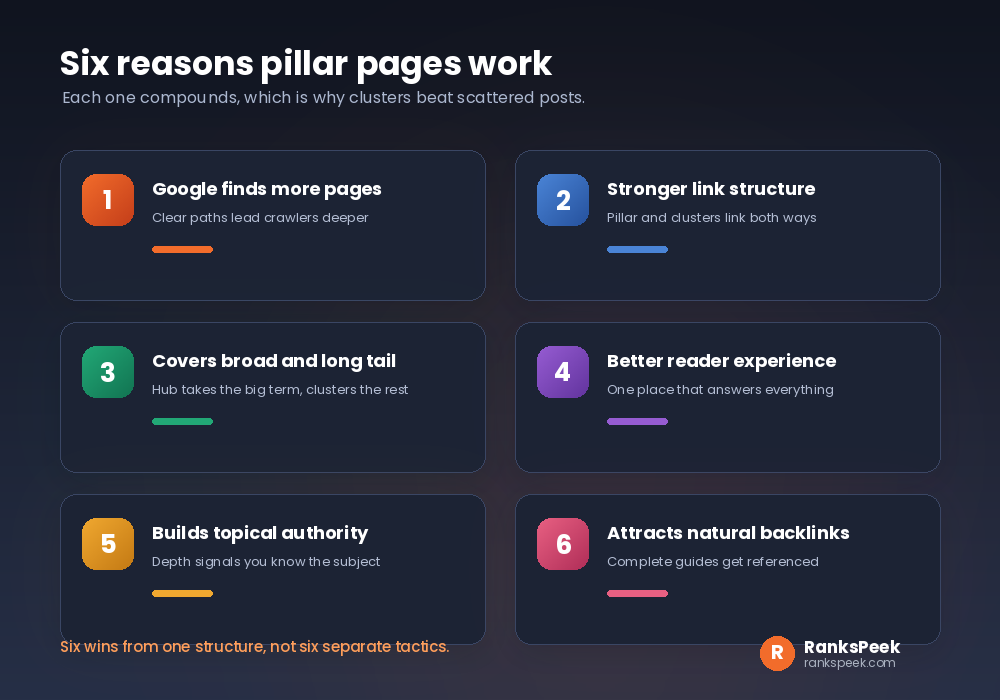
Here is where the theory becomes practical. Each benefit below feeds the next, which is why clusters compound over time.
1. Google finds more of your content
Pillar pages create clear paths for crawlers to follow. So pages buried deep in your site get discovered, instead of sitting unseen for months.
2. Your link structure gets stronger
Linking the pillar and clusters both ways builds a tight network. Consequently, readers navigate easily, and search engines learn which pages you consider most important.
3. You target broad and long tail keywords together
The pillar chases the big competitive term. Meanwhile, each cluster page picks off a specific long tail phrase. As a result, you rank for both the general topic and the detailed questions around it.
4. Readers get a better experience
One page that genuinely answers the whole question keeps people reading. So visits last longer, bounce drops, and more people reach the next step you want them to take.
5. You build topical authority
Depth is the signal. When your site covers a topic from every sensible angle, you look like a source worth trusting rather than a site that dabbled once.
6. You earn backlinks more easily
Complete guides get referenced. Indeed, other writers link to the resource that saves them explaining everything themselves, which is usually the pillar page.
Why Pillar Pages Matter More Than Scattered Posts
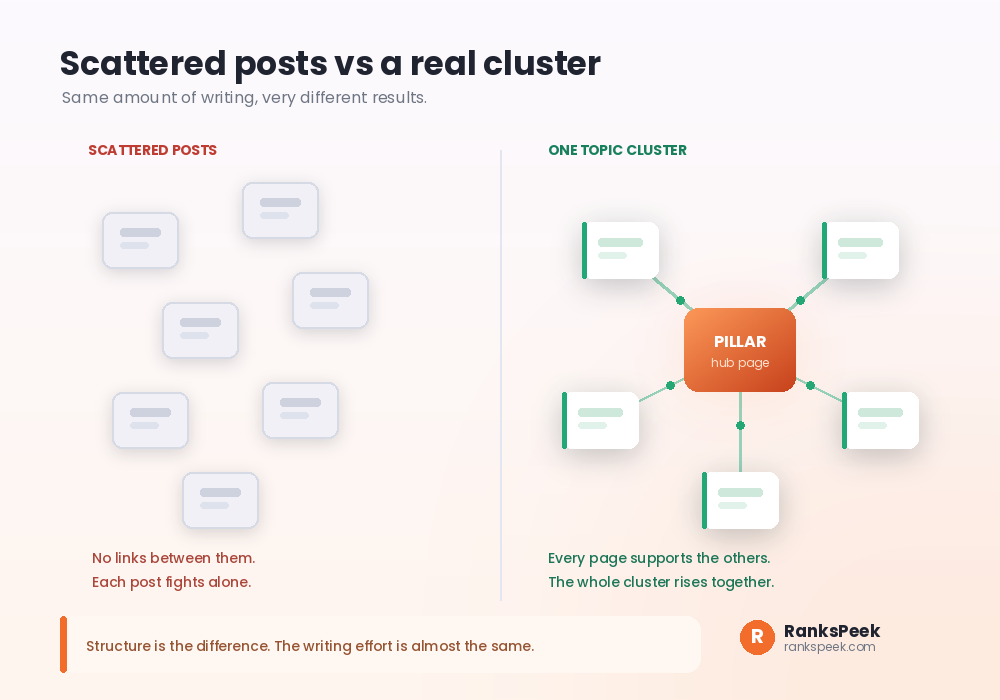
Picture two blogs that publish the same number of articles each month. The first posts whatever seems interesting, with no links between pieces. Every article competes alone, and nothing builds.
The second plans a cluster. One pillar covers the topic, several posts cover the parts, and all of them link together. Therefore each new post strengthens the others, and the whole group climbs.
Notably, the writing effort is almost identical, which is the clearest proof of why pillar pages matter. Structure is the only real difference, which is exactly why pillar pages are worth planning rather than hoping for.
Why Pillar Pages Matter in Practice: How to Build One
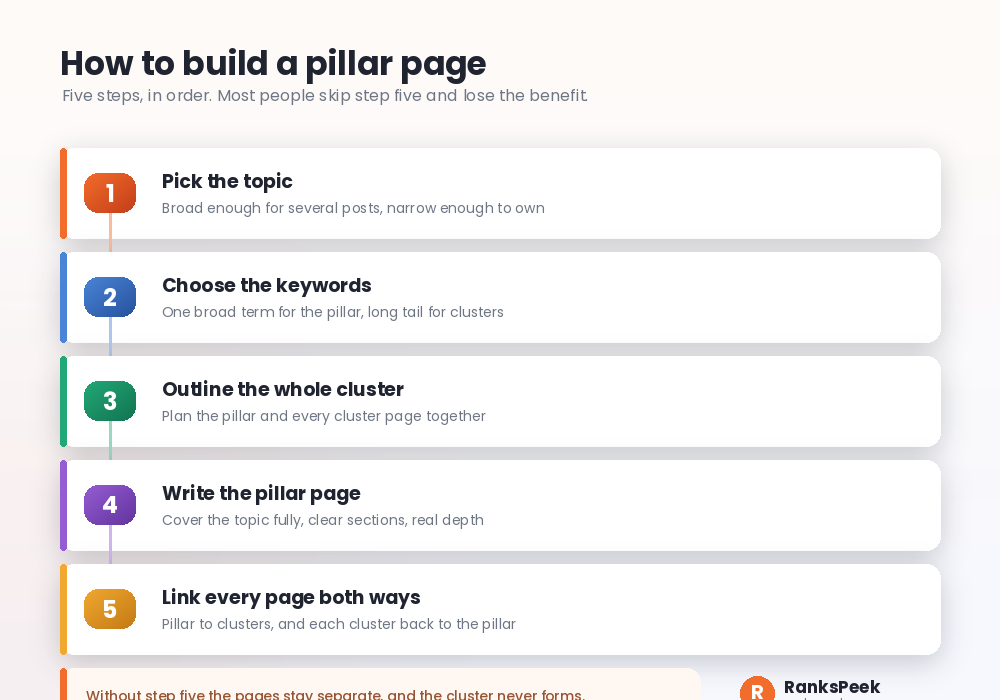
You do not need a big team for this. So work through these five steps in order.
- Pick the topic. Firstly, choose something broad enough for several posts, yet narrow enough that you can genuinely own it.
- Choose the keywords. Then take one broad term for the pillar and a long tail phrase for each cluster page. Our free Keyword Generator helps you find those variations.
- Outline the whole cluster. Also plan the pillar and every cluster page together, since deciding later leads to gaps and overlaps.
- Write the pillar page. Next, cover the topic fully with clear sections, real depth and honest detail, not a thin summary.
- Link every page both ways. Finally, link the pillar down to each cluster page, and every cluster page back to the pillar.
Step five is the one people forget. Without it the pages stay isolated, and the cluster never actually forms. Meanwhile, a quick check with our SEO Checker confirms each page is technically sound before you promote it.
Types of Pillar Pages and Examples
Pillar pages come in a few familiar shapes. So pick the one that suits your topic rather than forcing a format.
- The complete guide. Firstly, an all round resource that covers every angle of a subject for someone starting out.
- The how to guide. Then a step by step walkthrough of a process, with each major step expanded on its own cluster page.
- The resource hub. Also a curated central page that points to tools, articles and references on one theme.
For a plain example, imagine a site about home coffee. The pillar could be a full guide to brewing coffee at home. Meanwhile, cluster pages would cover choosing a grinder, the pour over method, water temperature, and storing beans. Each answers its own search, yet all of them point back to the pillar.
Mistakes That Waste Your Pillar Page Effort
A few habits quietly cancel the benefit, so watch for these.
Writing the pillar and stopping. One guide with no cluster pages is not a cluster. Therefore plan at least three or four supporting posts from the start.
Forgetting the return links. Cluster pages that never link back leave the pillar unsupported. So check every cluster page includes that link.
Overlapping subtopics. Two cluster pages targeting almost the same phrase compete with each other. Instead give each page a clearly separate question to answer.
Thin cluster pages. A cluster page still needs to stand alone and satisfy its own searcher. Consequently, a two paragraph placeholder helps nobody and can drag the cluster down.
A Cluster Lesson From Our Own Site
We build free SEO tools, so we learned this on RanksPeek the slow way. Early on we published articles as they came to mind. One on speed, one on backlinks, one on security, all unconnected.
Firstly we noticed something odd in Search Console. Several posts were discovered but not indexed, and others sat with almost no impressions. Secondly we realised why. Nothing linked to them, so nothing signalled that they mattered or how they related to each other.
So we started grouping. Our technical posts now link together and point at the tools they discuss, while our AI search posts form their own small cluster. The change was not dramatic overnight, yet crawling improved and pages stopped sitting alone. If you are seeing similar indexing gaps, our guide on technical issues that hold a WordPress site back covers the other half of that problem.
Why Pillar Pages Matter in AI Search and 2026
Why pillar pages matter has not changed in 2026, although search has. It now includes AI Overviews and assistants that summarise before anyone clicks. Even so, clusters have not lost value. If anything, they gained some, because these systems favour sources that clearly cover a topic in full.
The reason is consistent. A pillar page states the whole picture in one place, while cluster pages supply the detail. Therefore an AI system reading your site finds both the summary and the supporting depth, which is exactly what makes a source worth citing. For more on that shift, see our guides on generative engine optimization and AI agent readiness.
Frequently Asked Questions
What is an SEO pillar page, and why pillar pages matter?
It is a thorough page covering a broad topic that links to smaller cluster pages on related subtopics. The pillar targets the main keyword, while clusters target longer, more specific searches.
What is a pillar page example?
A complete guide to home coffee brewing, linking to separate posts on grinders, pour over method and bean storage. The guide is the pillar, and those posts are its cluster pages.
What is the difference between a landing page and a pillar page?
A landing page exists to convert, so it is short, focused and usually built around one offer. A pillar page exists to inform and rank, so it is long, educational and heavily linked to related content.
What is the difference between a hub page and a pillar page?
The terms overlap heavily and many people use them interchangeably. A hub page mainly signposts to other pages, whereas a pillar page teaches the topic itself and links out as well.
Why Pillar Pages Matter for a small blog?
They matter more, not less. A small site cannot outspend big brands, yet it can out organise them by covering one topic properly and linking it all together.
How many cluster pages does a pillar page need?
There is no fixed number. Three or four solid supporting posts are enough to start, and you can keep adding as the topic grows.
Final Thoughts
So Why Pillar Pages Matter comes back to structure. One deep guide, several focused posts, and links running both ways turn scattered writing into a cluster that Google understands and readers enjoy. Pick one topic you want to be known for, plan the pillar and its clusters together, then link them properly. Start by checking your keyword options with our free Keyword Generator.