AI Agent Readiness is the work of preparing your website so AI agents can read it, understand it, and act on it. These agents already book trips, compare products, and fill forms on behalf of real people. So the question is no longer whether AI agents will visit your site, but whether your site is ready when they do. This guide explains what AI agent readiness means, why it matters now, and the exact steps to get there.
Quick answer: AI Agent Readiness means building your website so AI agents can crawl it, understand it, and complete tasks on it. In practice that means clean structure, accurate data, clear labelled actions, and fast, open access. Good agent readiness overlaps almost entirely with good SEO, so most of the work also helps humans and search engines.
AI Agent Readiness: What It Really Means
For twenty years, websites were built for one visitor: a human with eyes. Then search engines arrived, and we learned to write for them too. Now a third visitor is showing up, an AI agent that acts on a person’s behalf, and it reads the web in its own way.
So AI agent readiness is simply the next step in that story. It asks a plain question. When an agent lands on your page to complete a task, can it find what it needs, trust what it reads, and act without getting stuck? If yes, your site is agent ready. If not, the agent moves on to a site that is.
Reassuringly, this is not a whole new discipline. Firstly, it builds on the clarity and structure that good SEO already rewards. Secondly, it makes those qualities explicit enough for a machine that cannot guess the way a person can.
What Is an AI Agent?
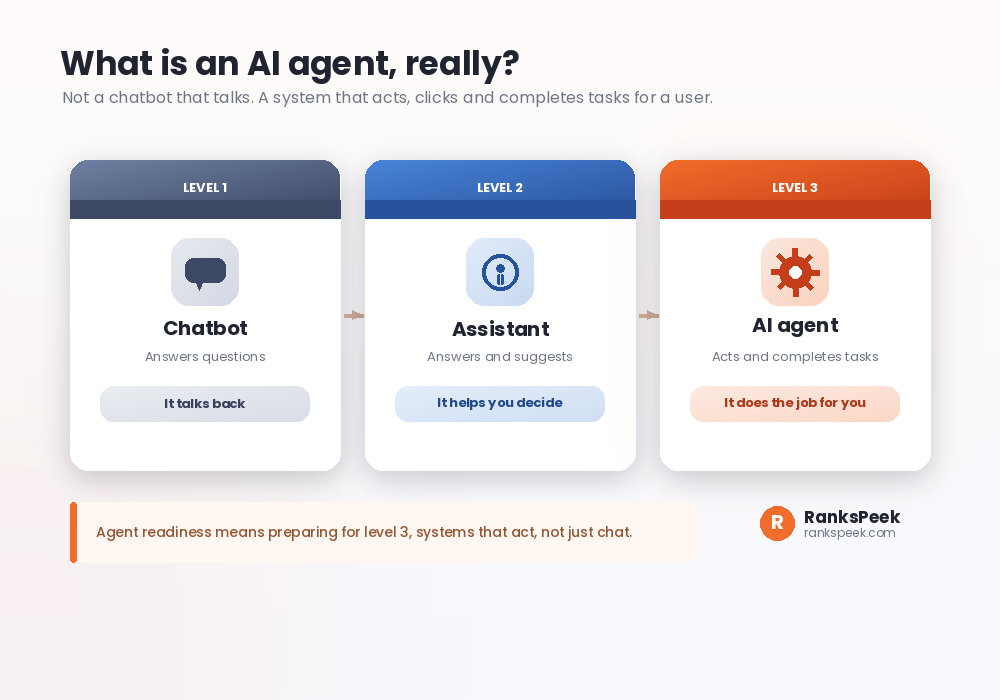
The word agent gets used loosely, so let us be precise. There is a ladder of capability, and an agent sits at the top.
- A chatbot answers questions. It talks back, and nothing more.
- An assistant answers and suggests. It helps you decide, but you still act.
- An AI agent acts and completes tasks. It does the job for you, clicking, filling and confirming along the way.
So when an agent shops for a flight, it does not just describe options. Instead it visits sites, reads prices, compares them and moves toward booking. Consequently, your site is no longer only being read. It is being used.
AI Agent Readiness: How Agents Read Your Site
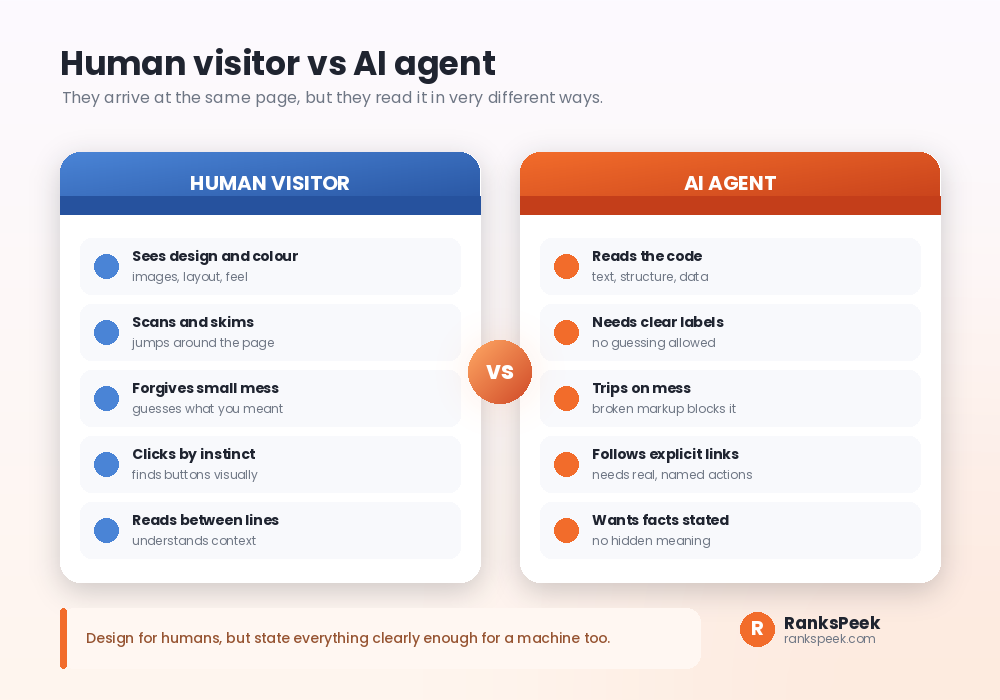
A human and an agent arrive at the same page, yet they experience it completely differently. Understanding that gap is the heart of AI agent readiness.
A human sees design, colour and layout. They scan, skim and jump around. They forgive small mistakes, because they guess what you meant. They click by instinct, and they read between the lines. An agent does none of this. Instead it reads the underlying code and text. It needs clear labels, because it cannot guess. It trips on broken markup, it follows only explicit links, and it wants facts stated plainly, with no hidden meaning.
Therefore the goal is not to strip out design for humans. Rather, it is to make sure everything a human understands by instinct is also stated clearly enough for a machine.
The Six Pillars of AI Agent Readiness
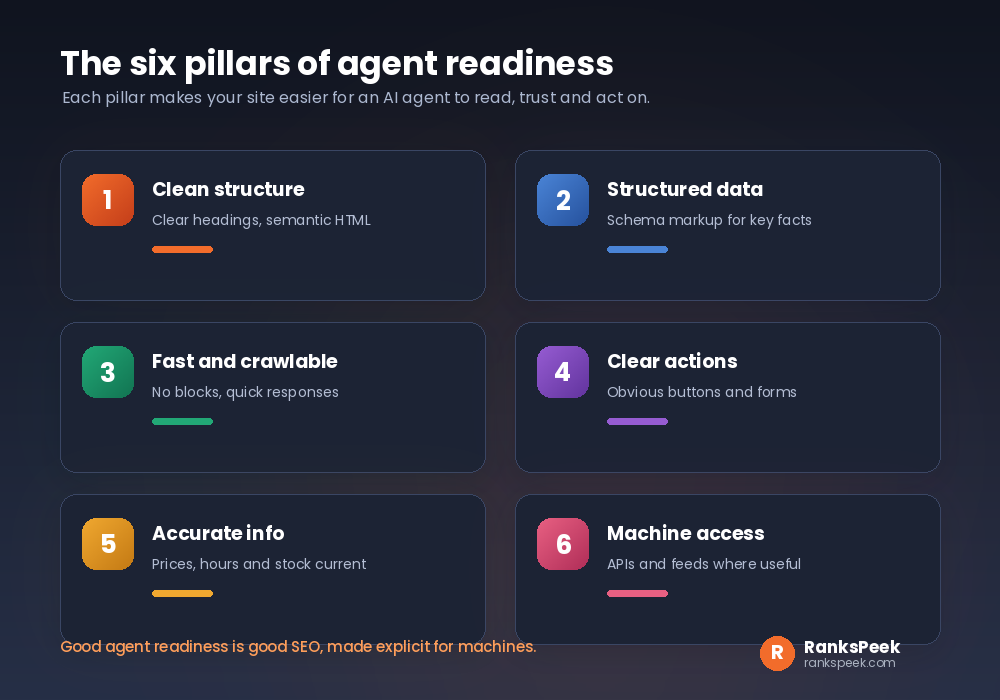
Agent readiness rests on six pillars. Notably, each one also strengthens ordinary SEO, which is why this work pays off twice.
1. Clean structure
Use real semantic HTML, with proper headings, lists and landmarks, rather than styled divs. So an agent can map your page instantly instead of untangling it.
2. Structured data
Add schema markup for your key facts, like products, articles and business details. Then an agent reads a price or an address as data, not as a guess from surrounding text.
3. Fast and crawlable
Keep the site quick and open, with no needless blocking of bots. Because a slow or blocked page is one an agent simply abandons, exactly as we cover in our guide on why your WordPress site is slow.
4. Clear actions
Make every button and link say what it does, in plain text. So an agent trying to book, buy or contact can find the right action without visual guessing.
5. Accurate information
Keep prices, hours and stock current. Meanwhile, an agent that acts on stale data creates a bad outcome, and your brand wears the blame.
6. Machine access
Where it fits, offer clean feeds or APIs. Similarly, secure delivery matters, which is why our guide on whether HTTPS affects SEO is worth a read alongside this one.
AI Agent Readiness Checklist
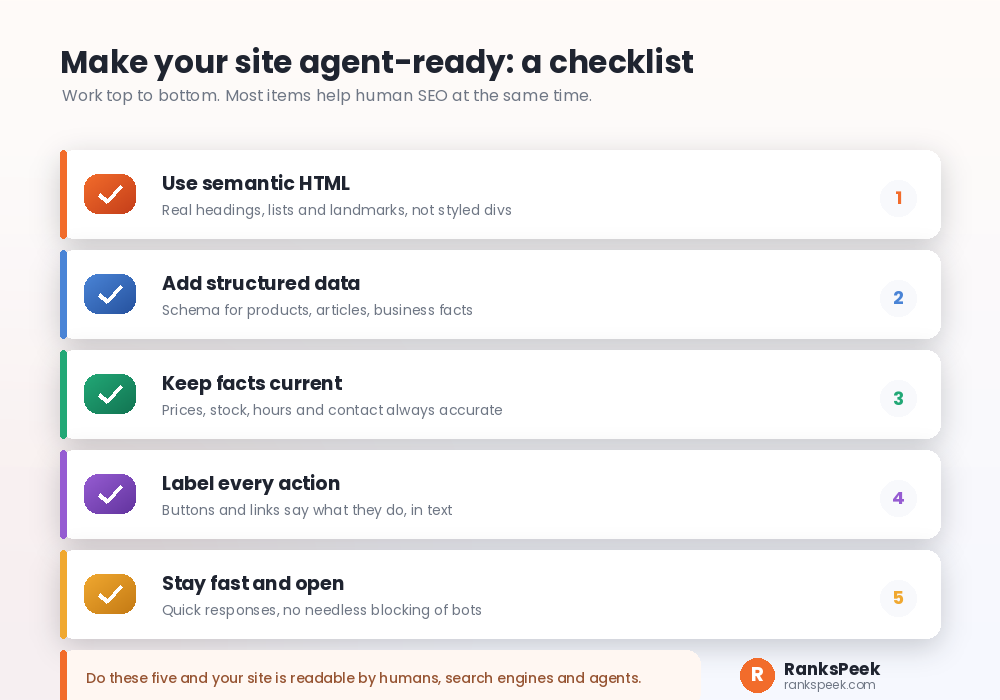
Here is where the idea turns into action. Work top to bottom, and test as you go.
- Use semantic HTML. Firstly, replace styled divs with real headings, lists and landmarks.
- Add structured data. Then mark up products, articles and business facts with schema.
- Keep facts current. Also make sure prices, stock, hours and contact details are always accurate.
- Label every action. Next, ensure buttons and links describe what they do in words.
- Stay fast and open. Finally, keep responses quick and avoid blocking legitimate bots.
Do these five, and your site becomes readable by humans, search engines and agents at once. You can check the technical side of this with our free SEO Checker and PageSpeed Insights tools.
Why AI Agent Readiness Matters Right Now
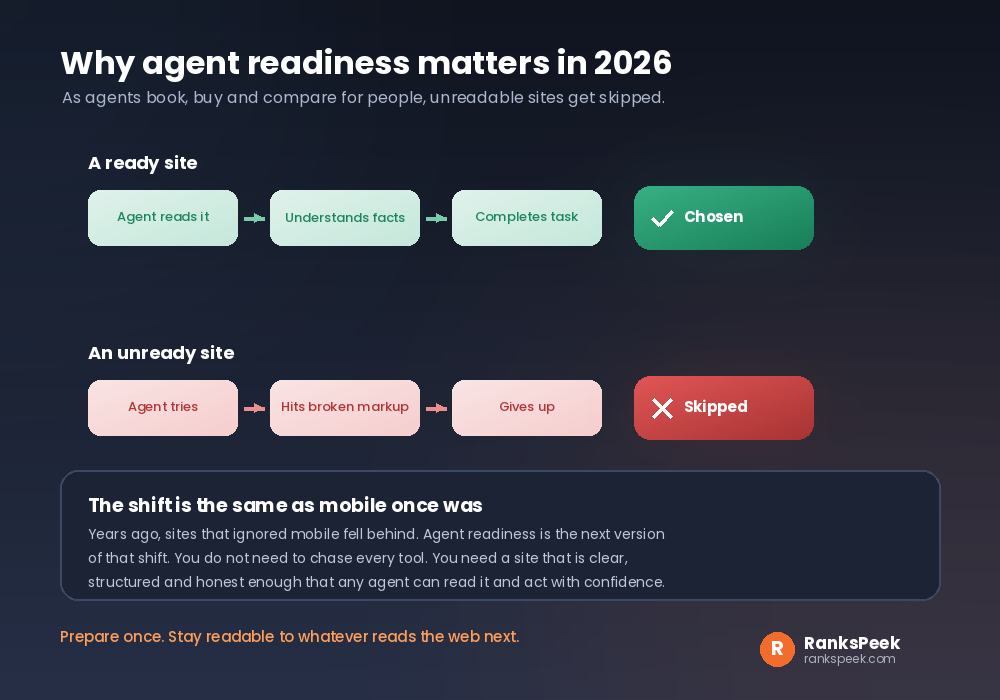
Picture two sites when an agent goes to complete a task. The ready site gets read, understood and used, so it wins the sale or the booking. The unready site trips the agent on broken markup, so the agent gives up and moves on. Over thousands of tasks, that gap compounds.
Here is the useful comparison. Years ago, sites that ignored mobile fell behind as phones took over. Agent readiness is the next version of that same shift. So you do not need to chase every new tool or platform. Instead you need a site that is clear, structured and honest enough that any agent can read it and act with confidence.
An Agent Readiness Lesson From Our Own Site
We build free SEO tools, so we watch these shifts closely on RanksPeek. Here is a lesson that maps straight onto agent readiness.
Early on, none of our pages appeared anywhere, for humans or machines. The cause was dull but total. A stale cache was serving our blog pages with an old noindex tag, so nothing could read them. Firstly we purged the cache. Secondly we fixed the sitemap. Only then could a crawler, and by extension any agent, actually reach the content.
The lesson is simple and it comes first. Before any clever readiness tactic, get the basics right: crawlable pages, clean markup, a correct sitemap and fast load times. An AI agent cannot act on a page it cannot even open. If you are still fighting indexing gremlins, our guide on what a canonical URL is in SEO and our piece on generative engine optimization pair well with this one.
AI Agent Readiness, AI Overviews and 2026
Through 2026, AI agents and AI Overviews keep taking on more of the journey. People increasingly ask an assistant to compare, shortlist or even buy, rather than browsing every site themselves. Consequently, being readable to these systems moves from a nice extra to a real advantage.
The good news repeats itself. The fundamentals have not changed, they have simply become non negotiable. Clear structure, honest data, fast pages and labelled actions were always smart. Now they are also how an agent decides whether to use your site or skip it. For the wider picture, read our roundup of the latest SEO trends and our search everywhere optimization guide.
Frequently Asked Questions
What is AI Agent Readiness in simple words?
It is making your website clear and structured enough for AI agents to read it and complete tasks on it. In short, it prepares your site for visitors that act, not just visitors that browse.
Is agent readiness different from SEO?
It overlaps heavily. Clean structure, fast pages and accurate data help both. Agent readiness simply adds a focus on labelled actions and machine readable facts on top of solid SEO.
Do I need special technology for AI agents?
Usually not. Most gains come from semantic HTML, schema markup and accurate content. So the work is cleanup and clarity, not exotic new tools.
Will AI agents replace normal website visitors?
No. Humans still visit directly. Agents are an additional audience, so you prepare for both rather than choosing one over the other.
How do I test my AI Agent Readiness?
Check the basics first. Is it fast, crawlable and free of broken markup? Are your key facts marked up with schema and kept current? If yes, you are most of the way there.
Where should a small site start?
Start with structure and accuracy. Firstly fix headings and semantic HTML. Then add schema for your main facts and keep prices and hours current. Those steps deliver the most for the least effort.
Final Thoughts
AI Agent Readiness is not about chasing hype. It is about making your website clear enough that any reader, human, search engine or agent, can understand it and act. Reassuringly, the path is familiar: clean structure, accurate data, labelled actions and a fast, open site. Start by testing your foundation with our free SEO Checker, then work down the checklist above.