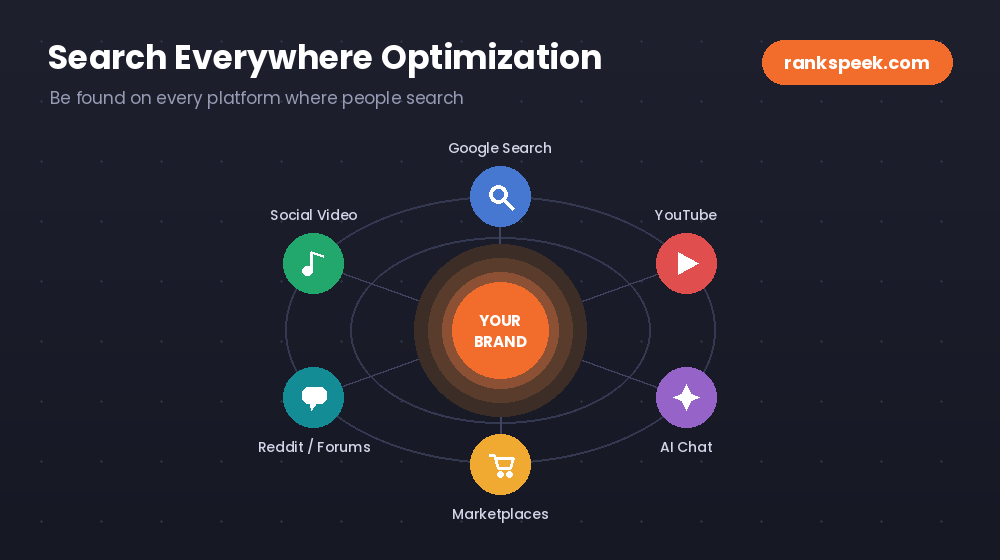
This search everywhere optimization guide covers the biggest shift happening in SEO right now: people no longer search only on Google. They discover brands in social videos, compare products on YouTube, check honest opinions on forums, ask AI chatbots for recommendations, and search directly inside marketplaces. Ranking number one on Google still matters, but it is no longer the whole game. In this guide you will learn what search everywhere optimization means, how the modern search journey works, and a simple 5-step plan to show up wherever your audience is looking.
Search everywhere optimization means making your brand visible on every platform where people search, not just Google. That includes YouTube, social video, forums and communities, marketplaces, and AI chat tools. Instead of only optimizing web pages for rankings, you optimize your brand’s presence across the entire journey people take from discovering a product to buying it.
What Is Search Everywhere Optimization?
Search everywhere optimization is the practice of building visibility and trust for your brand across every platform where people search and make decisions. Some people call it omnichannel SEO, and it overlaps with newer terms like AEO (Answer Engine Optimization) and GEO (Generative Engine Optimization). The idea behind all of them is the same: search no longer lives on one website. Your customers might meet your brand in a short video, look you up on YouTube, read what strangers say about you in a community thread, and ask an AI assistant if you are worth trying, all before they ever visit your site.
Why Google Alone Is Not Enough Anymore
Google is still where most searches start, and it deserves the biggest share of your effort. But a fast-growing slice of search now happens elsewhere: inside video apps, marketplaces, communities, and AI chat tools. Each of those moments can win or lose a customer. If a shopper finds you on Google but sees nothing about you on YouTube and no real opinions in communities, doubt creeps in, and doubt loses sales. The brands winning right now are the ones that show up consistently across the whole journey, so every check a customer makes confirms the same story.
The Modern Search Journey
Here is what a typical journey looks like today:
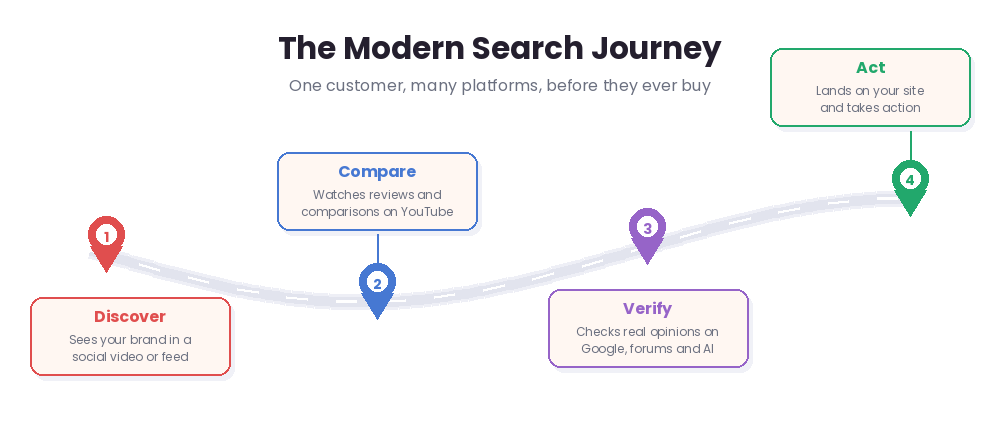
- Discover. They first notice your brand in a social video, a feed, or a search result.
- Compare. They watch reviews and comparisons, often on YouTube, to shortlist options.
- Verify. They check unfiltered opinions on forums, Google results, and increasingly in AI answers.
- Act. They land on your website or listing and make the purchase or signup.
Real journeys are messier than this, with people jumping back and forth between platforms for days. That is exactly why being present at every stop matters: missing one step can quietly hand the customer to a competitor who showed up where you did not.
Two Sides: Managed vs Influenced Presence
Every touchpoint in the journey falls into one of two groups, and each needs a different approach:
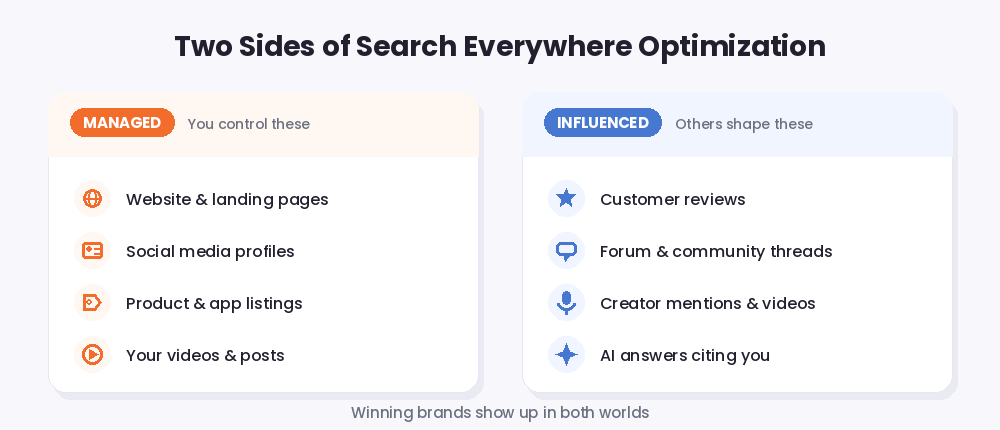
Managed presence is everything you directly control: your website, your social profiles, your product listings, and the content you publish. Here your job is quality and consistency, including fast pages, clear messaging, and complete profiles on every platform that matters to your audience.
Influenced presence is everything others say about you: customer reviews, community threads, creator videos, and AI answers that mention your brand. You cannot control these, but you can influence them by delivering a great product, encouraging honest reviews, engaging respectfully in communities, and creating content worth citing. Influenced presence is becoming especially important because AI tools often learn about brands from third-party sources rather than from the brand’s own website.
Search Everywhere Optimization Guide: The 5-Step Plan
Here is a simple plan any website owner can follow:
- Step 1. Learn where your audience searches. Ask customers how they found you, and note which platforms come up. Different audiences live on different platforms.
- Step 2. Audit your presence. Search your brand and your main topics on each platform. Mark each one as strong, weak, or missing. Also audit your own site with our free SEO Checker, because your website is still the center of everything.
- Step 3. Fix your foundation first. A slow or confusing website wastes every visit you earn elsewhere. Test speed with PageSpeed Insights and make sure every key page has clean titles and descriptions using the Meta Tags Analyzer.
- Step 4. Create for each platform. Research what people ask with the Keyword Generator and Long Tail Keyword tool, then answer those questions in the format each platform expects: articles for search, videos for YouTube, short clips for social, honest participation in communities.
- Step 5. Repurpose and track. Turn one strong article into a video, an infographic, and social posts. Then watch your growth: rankings and clicks in Google Search Console, and your site’s rising authority with the DA PA DR Checker.
Does Traditional SEO Still Matter?
Completely. Search everywhere optimization does not replace SEO; it builds on top of it. Keywords, helpful content, technical health, and backlinks still decide how you perform on Google, which remains the biggest platform by far. Google’s own Search Central documentation is still essential reading. The shift is in scope: traditional SEO gets you found on Google, while search everywhere optimization gets you chosen across every platform where your customer is deciding. Do the fundamentals first, then extend them outward.
Search Everywhere Optimization in 2026
In 2026 this approach has moved from optional to essential. Google’s results now blend AI Overviews, videos, forum threads, and classic links on a single page, so one piece of content can appear in several ways. AI assistants recommend brands based on what the wider web says about them, which makes reviews, community reputation, and creator mentions direct ranking assets. And Google’s own search updates keep pushing toward rewarding genuine helpfulness wherever it lives. The practical takeaway: keep your website strong, but treat every platform where your audience searches as part of your SEO.
Frequently Asked Questions
What is search everywhere optimization?
It is the practice of building visibility for your brand on every platform where people search, including Google, YouTube, social video, forums, marketplaces, and AI chat tools, instead of optimizing for Google alone.
Is search everywhere optimization the same as GEO or AEO?
They overlap. GEO and AEO focus on getting cited in AI-generated answers, while search everywhere optimization is the wider strategy that covers AI answers plus every other platform where discovery happens.
Does this replace traditional SEO?
No. Traditional SEO remains the foundation, because Google is still the biggest search platform. Search everywhere optimization extends the same principles to more platforms.
Which platforms should a small website focus on?
Start with Google and your own website, then add the one or two platforms your audience actually uses most. A focused presence on two platforms beats a weak presence on ten.
How do I know if it is working?
Track more than rankings: watch branded searches, mentions of your site, traffic sources in your analytics, and your growing authority metrics over time.
Search has spread everywhere, and that is good news for brands willing to show up. Start with your foundation today: run your site through our free SEO Checker and build outward from strength.
The RanksPeek Team builds free SEO tools that help website owners check authority, backlinks, keywords, speed and more, with no signup needed. Explore all 17 free tools →