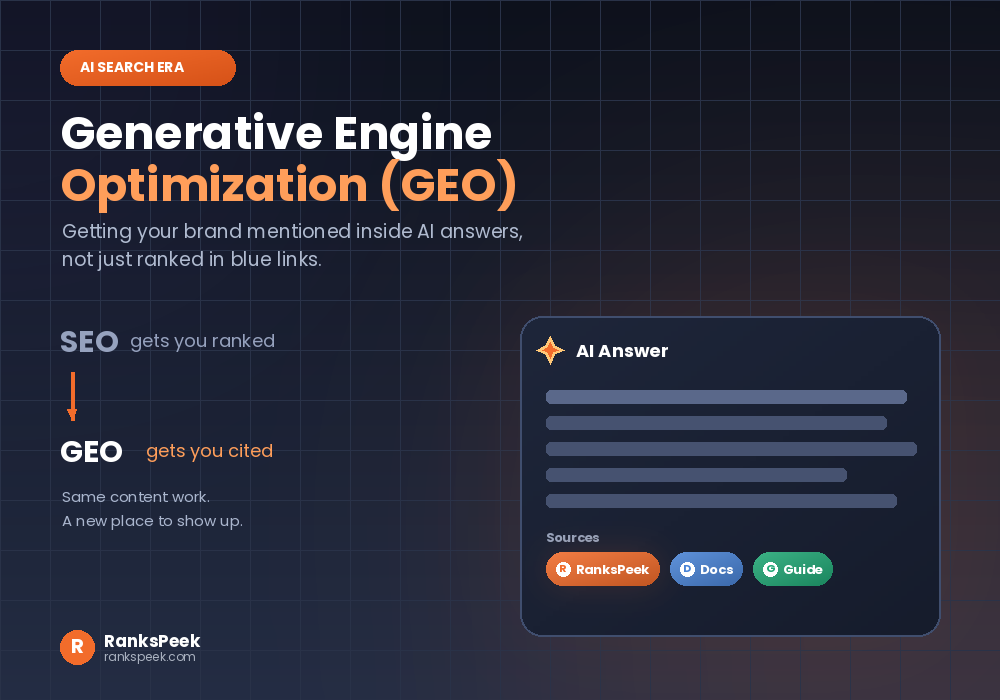
Generative Engine Optimization GEO Definition is easier than the name suggests. GEO is the practice of getting your content mentioned and cited inside AI generated answers, like Google’s AI Overviews and chatbot replies, instead of only ranking in the classic list of blue links. So while traditional SEO fights for a top position, generative engine optimization fights to be the source the AI actually quotes. This guide gives you the full GEO definition, then shows you how to earn those citations.
Quick answer: The Generative Engine Optimization GEO definition is the process of optimizing your content so AI powered search engines mention, quote and cite it in their generated answers. GEO does not replace SEO. Instead it sits on top of solid SEO, focusing on clarity, structure, credibility and firsthand proof, so an AI engine chooses your page as a source worth naming.
Generative Engine Optimization GEO Definition, in Plain Words
Search used to work one way. You typed a query, and the engine handed you a list of links. You clicked one, and you read the page. Now a second path exists. You ask a question, and an AI writes a direct answer, often citing a few sources along the way.
That shift created a new job, and the Generative Engine Optimization GEO definition names it. The Generative Engine Optimization GEO definition describes the work of making your content the kind an AI wants to cite. So the target moved. Firstly, you still want to rank. Secondly, and increasingly, you want to be named inside the answer itself.
The term GEO grew popular through 2024 and 2025 as AI Overviews and chatbots became everyday tools. Notably, it is not a rejection of SEO. Rather, it is an extension, because an AI engine cannot cite a page it cannot first find and read.
Generative Engine Optimization GEO Definition vs SEO
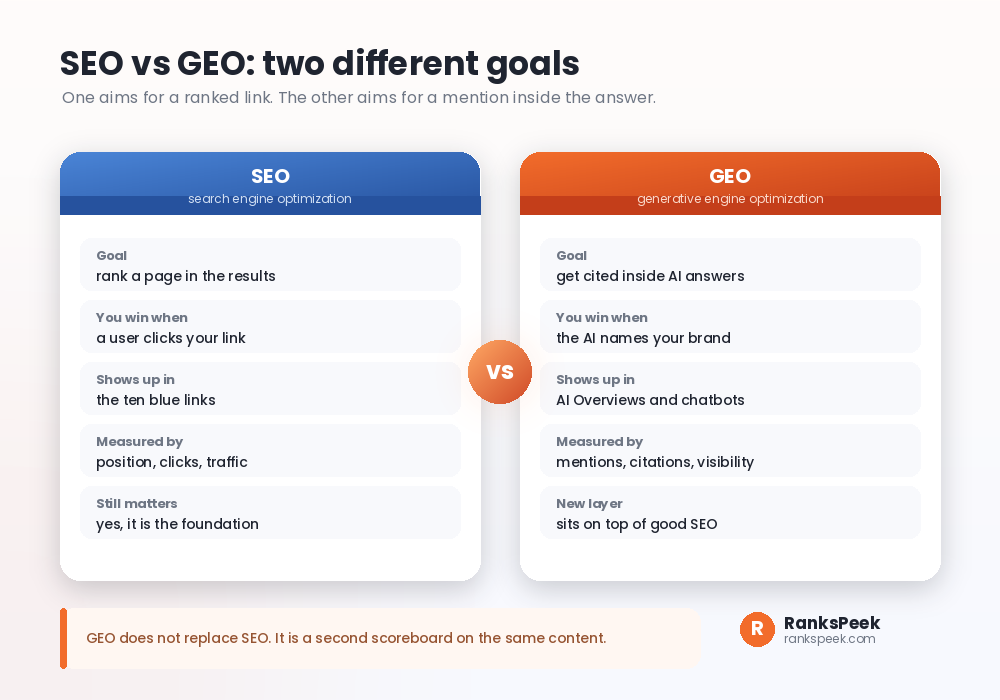
To sharpen the Generative Engine Optimization GEO definition, compare it with plain SEO. The two overlap heavily, yet they aim at different finish lines. SEO wins when a user clicks your ranked link. GEO wins when an AI names your brand in its answer, whether or not a click follows.
| Angle | Traditional SEO | GEO |
|---|---|---|
| Goal | Rank a page high | Get cited in the answer |
| You win when | A user clicks your link | The AI names your brand |
| Appears in | The ten blue links | AI Overviews and chatbots |
| Measured by | Position, clicks, traffic | Mentions, citations, visibility |
Here is the reassuring part. The work overlaps almost entirely. Clear writing, real expertise, clean structure and a fast, crawlable site help both. So you are not starting over. Instead you are adding a second scoreboard to content you already publish.
Generative Engine Optimization GEO Definition: How Engines Choose Sources
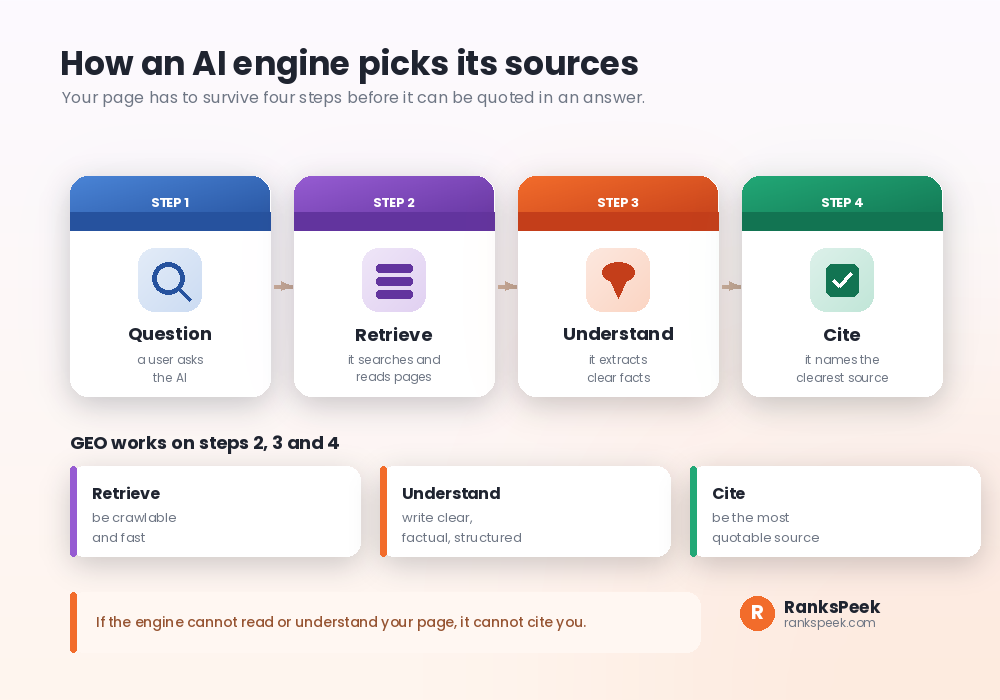
To optimize for something, you first need to understand it. Most generative engines follow four steps. The user asks a question. The engine retrieves and reads relevant pages. It then extracts clear facts it can trust. Finally, it writes an answer and cites the clearest sources.
GEO acts on the middle steps. Firstly, your page must be retrievable, which means crawlable and fast. Secondly, it must be understandable, which means factual and well structured. Thirdly, it must be quotable, which means it states clear answers the engine can lift without guessing. Consequently, a vague, cluttered page rarely gets cited, however clever it sounds.
Where Your Brand Can Appear
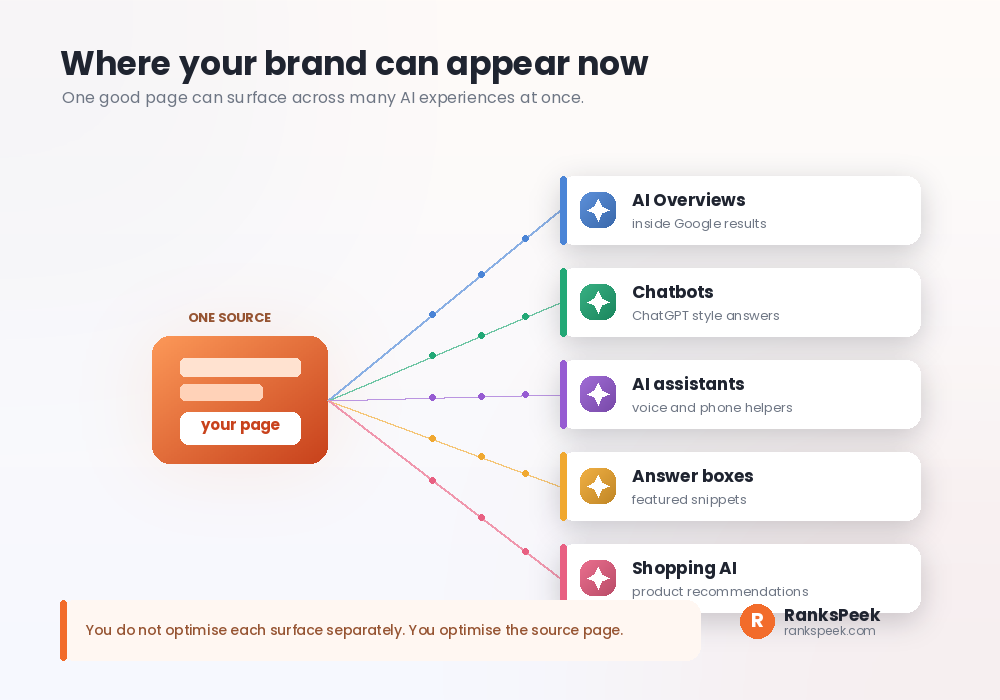
One well optimized page can surface in many places at once. AI Overviews sit inside Google results. Chatbots answer in a conversation. Voice assistants read answers aloud. Answer boxes and shopping tools pull from the same pool of trusted pages.
The key insight is simple, and it sits at the heart of the Generative Engine Optimization GEO definition. You do not optimize separately for each surface. Instead you optimize the source, because all these experiences draw from the same crawled, understood, credible content. So one strong page does the heavy lifting everywhere.
Generative Engine Optimization GEO Definition to Action: Six Moves
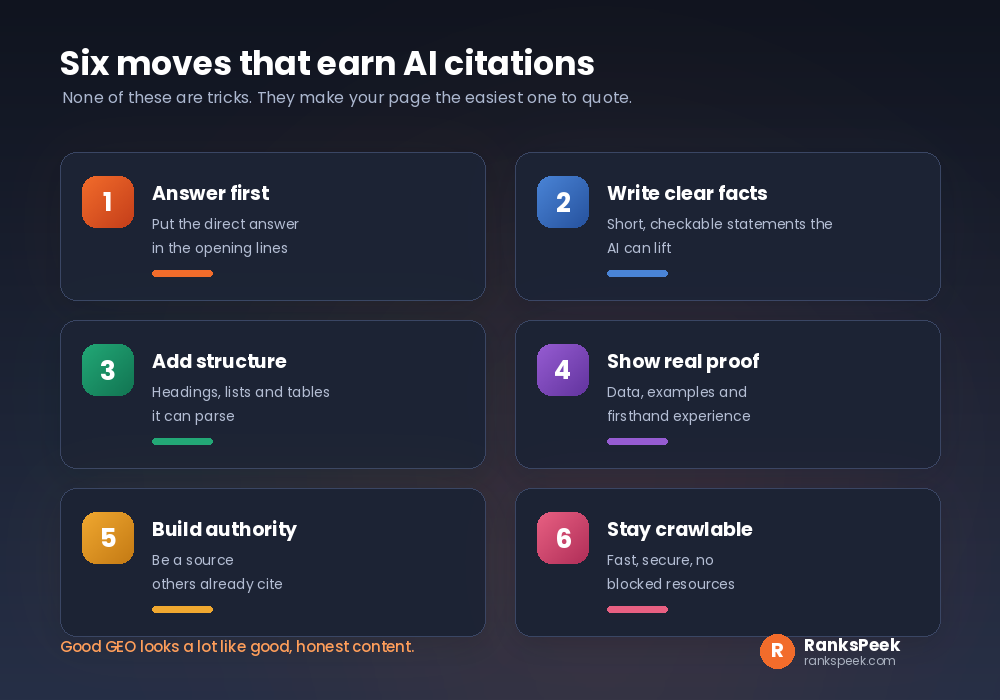
Here is where the GEO definition turns into a checklist. None of these are tricks. Each one simply makes your page the easiest to quote.
- Answer first. Firstly, put the direct answer in the opening lines, because engines lift concise answers, not slow build ups.
- Write clear facts. Then use short, checkable statements the AI can quote without risk.
- Add structure. Also use headings, lists and tables, since a machine parses structure far better than a wall of text.
- Show real proof. For example, add data, examples and firsthand experience that a generic page cannot fake.
- Build authority. Meanwhile, become a source others already cite, because engines favour pages the wider web trusts.
- Stay crawlable. Finally, keep the site fast, secure and unblocked, or none of the above matters.
Notice the pattern. Good GEO looks remarkably like good, honest content. In fact, most of these moves also strengthen your standing in normal search, which is exactly why they are worth doing. Our guide on what E-E-A-T means in SEO covers the credibility side in depth.
Generative Engine Optimization GEO Definition: How to Measure It
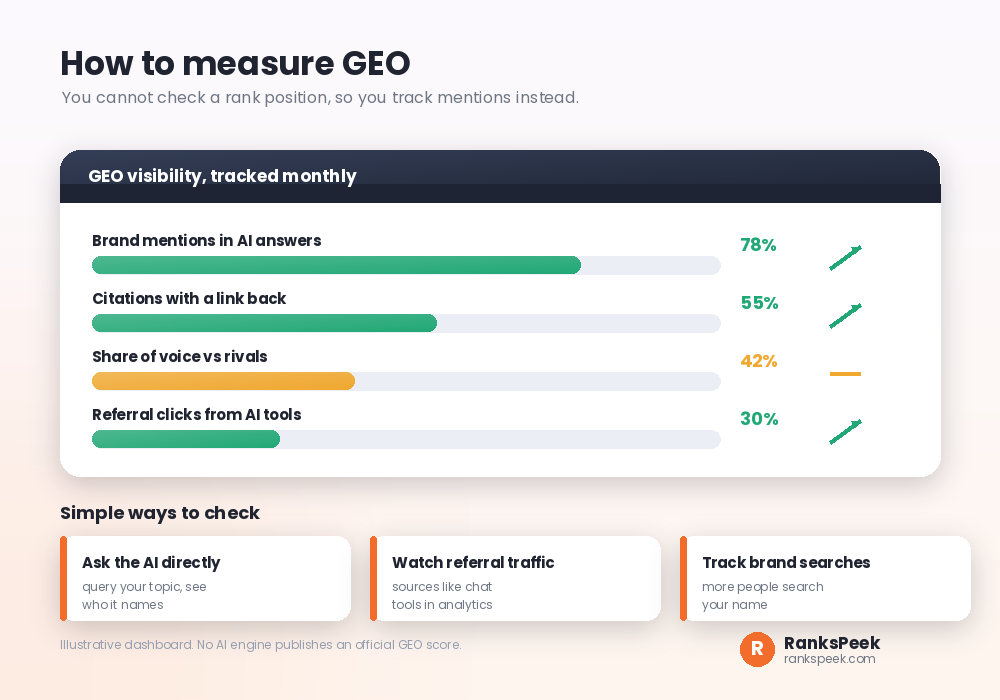
This is where GEO feels strange at first. There is no rank position to check, because an AI answer is not a ranked list. So you measure visibility differently.
Track a few honest signals. Firstly, brand mentions inside AI answers, by asking the engines your own topic questions and noting who they name. Secondly, referral clicks from AI tools, which show up in your analytics. Thirdly, branded searches, since people who saw you in an answer often search your name later. There is no official GEO score from any engine, so treat every tool that claims one with caution.
A GEO Lesson From Our Own Site
We build free SEO tools, so we watch this shift closely on RanksPeek. Here is something practical we learned early.
When we started, our pages did not appear anywhere, not in links and certainly not in AI answers. The reason was dull but decisive. Our blog pages were being served with an old noindex tag by a stale cache, so search engines skipped them entirely. Firstly we purged the cache. Secondly we fixed our sitemap. Only then could anything, human or machine, actually read our content.
The lesson maps directly onto the GEO definition. An AI engine cannot cite what it cannot crawl. So before any clever GEO tactic, get the boring technical layer right: crawlable pages, a clean sitemap, fast load times and no accidental blocks. We cover that groundwork in our guide on why your WordPress site is slow and our explainer on whether HTTPS affects SEO.
GEO, AI Overviews and 2026
Through 2026, AI answers keep taking more space at the top of results, and more people ask assistants directly instead of scrolling. So the question is no longer whether GEO matters, but how quickly you adapt.
The good news bears repeating. The fundamentals have not changed, they have hardened. Clear answers, honest facts, real experience and a technically sound site were always smart. Now they are also how you get cited by machines. For the wider view, read our roundup of the latest SEO trends, our take on whether SEO is dead or evolving in 2026, and our search everywhere optimization guide.
Frequently Asked Questions
What is the simple Generative Engine Optimization GEO definition?
It is optimizing your content so AI powered search engines mention and cite it in their answers. In short, SEO aims for a ranked link, while GEO aims for a citation inside the AI response.
Does GEO replace SEO?
No. GEO builds on SEO. An engine cannot cite a page it cannot crawl or understand, so strong SEO is the foundation that GEO sits on top of.
Is GEO the same as AEO or AI SEO?
They overlap heavily. Different writers use GEO, AEO and AI SEO for roughly the same idea: getting your content into AI generated answers. The core work is the same.
How do I start with GEO today?
Firstly, make sure your site is crawlable and fast. Then answer questions clearly and early on the page, add structure, and show real proof. Those steps help both AI answers and normal search.
Can I track my GEO results?
Partly. You cannot check a rank, but you can track brand mentions in AI answers, referral clicks from AI tools, and branded searches over time. No engine offers an official score.
Does GEO work for small sites?
Yes. In fact clarity and firsthand experience, which small honest sites do well, are exactly what engines like to cite. You do not need to be a huge brand to be quoted.
Final Thoughts
So the Generative Engine Optimization GEO definition comes down to one shift. Stop aiming only for a ranked link, and start aiming to be the source an AI trusts enough to name. Reassuringly, the path is familiar: clear answers, real proof, clean structure and a fast, crawlable site. Start by checking your technical foundation with our free SEO Checker, then make every page the easiest one to quote.