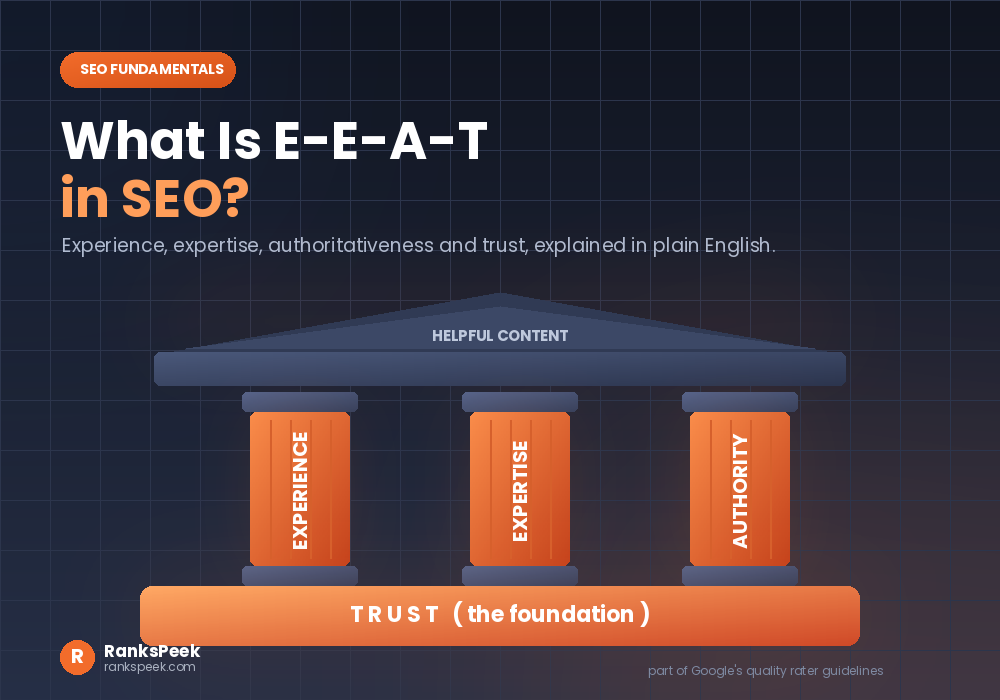
What is E-E-A-T in SEO is one of the first questions people ask when a page refuses to rank. So here is the plain answer. E-E-A-T stands for experience, expertise, authoritativeness and trust. Google uses those four words inside its Search Quality Rater Guidelines to describe what a genuinely useful page looks like. In other words, when you ask what is E-E-A-T in SEO, you are really asking how you prove to a stranger that your page deserves belief.
Here is the good news. You do not need a degree to pass this bar. Instead you need to show your work, name yourself, and stay honest about what you know. So let us break the four letters down properly, and then turn them into things you can actually do this week.
Quick answer: What is E-E-A-T in SEO? It stands for Experience, Expertise, Authoritativeness and Trust. These are quality guidelines that Google’s human raters use to judge content, especially on topics that affect health, money or safety. E-E-A-T is not a direct ranking factor. Even so, the qualities it describes are exactly what Google’s ranking systems try to reward.
What Is E-E-A-T in SEO? The Short Answer
Firstly, E-E-A-T is a quality standard rather than a score. Google publishes a long document for the people it pays to review search results. Notably, those reviewers are called quality raters. Naturally, Google needs them to judge pages consistently, so it gives them shared language. So that shared language is E-E-A-T.
Originally the acronym began life as E-A-T. Then in December 2022 Google added a second E for Experience. Consequently the guidelines now ask a very human question. In other words, has the person writing this actually done the thing they describe?
So when someone asks what is E-E-A-T in SEO, the honest reply is this. It is Google writing down what a trustworthy page looks like, so that both raters and ranking systems can chase the same target.
What Is E-E-A-T in SEO Made Of? The Four Parts
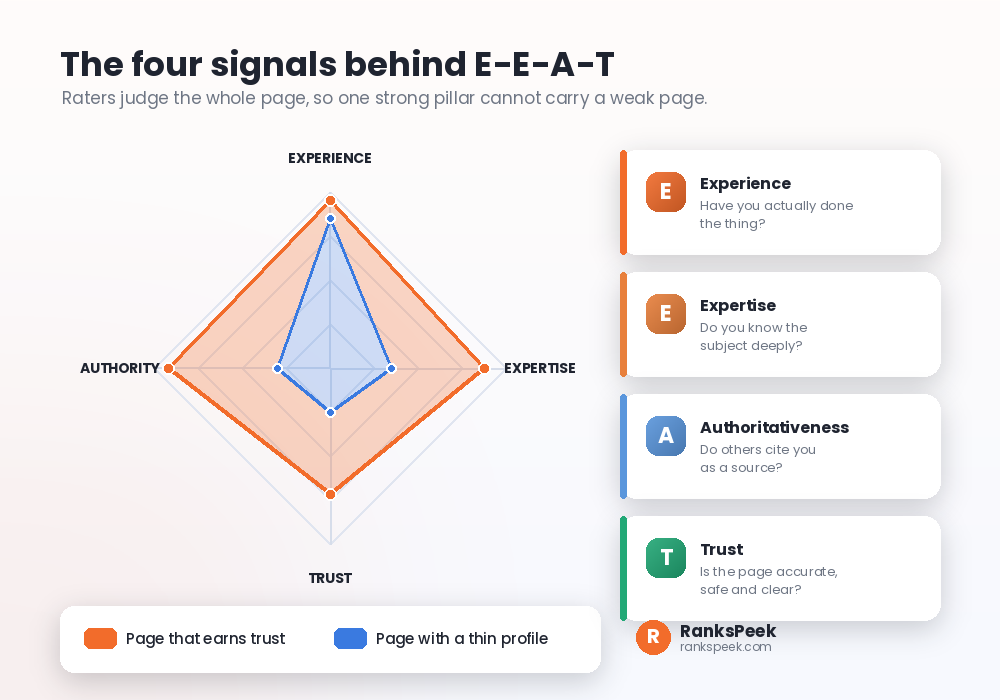
To clarify, each letter answers a different question. Therefore a page can be strong on one and weak on another. In fact raters look at the whole shape, rather than a single spike.
Experience: have you actually done it?
Experience is the newest letter, and also the easiest to prove. Specifically, it asks whether the content comes from firsthand use. For example, a review written after months of daily use beats a rewrite of the spec sheet. Similarly, a travel guide with your own photos beats a summary of other guides.
So show experience with original photos, real screenshots, your own measurements, and honest notes about what went wrong. Above all, include the small details that only a person who was there would know.
Expertise: do you know the subject deeply?
Expertise is about knowledge. In particular, formal credentials matter a great deal for medical, legal or financial topics. However, expertise is not limited to certificates. For example, a repair shop owner with twenty years on the tools has real expertise, even without a diploma on the wall.
So demonstrate it. Firstly, publish consistently in one niche. Then explain the edge cases that beginners never mention. Answer the awkward follow up questions instead of dodging them.
Authoritativeness: do others treat you as a source?
Authority is simply what other people say about you. In short, you cannot declare it yourself. It grows when respected sites cite you, mention you, or send readers your way.
Meanwhile, you can watch this growth with third party metrics. Our free DA PA DR Checker shows how link based authority scores compare across sites, while our guide on Trust Flow and Citation Flow explains the quality side of that picture. Remember though, these are third party scores. In other words, Google does not use them.
Trust: is the page safe, accurate and honest?
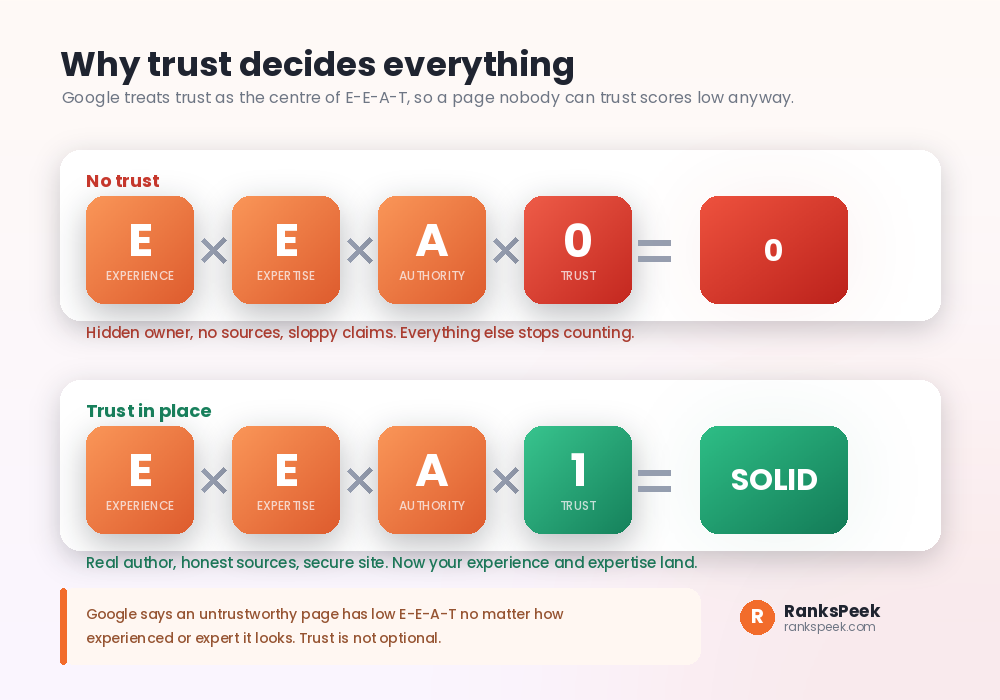
Trust sits at the centre of the whole family. Indeed Google is unusually blunt about this point. An untrustworthy page scores low, however experienced, expert or authoritative it may appear.
Trust comes from unglamorous things. For instance, a real contact page helps. Similarly, accurate claims with sources help. Also, HTTPS belongs on every page. Meanwhile, ownership must be clear, and honest disclosure matters whenever a link earns you money. Get these wrong and the other three letters simply stop counting.
What Is E-E-A-T in SEO Not? It Is Not a Ranking Factor
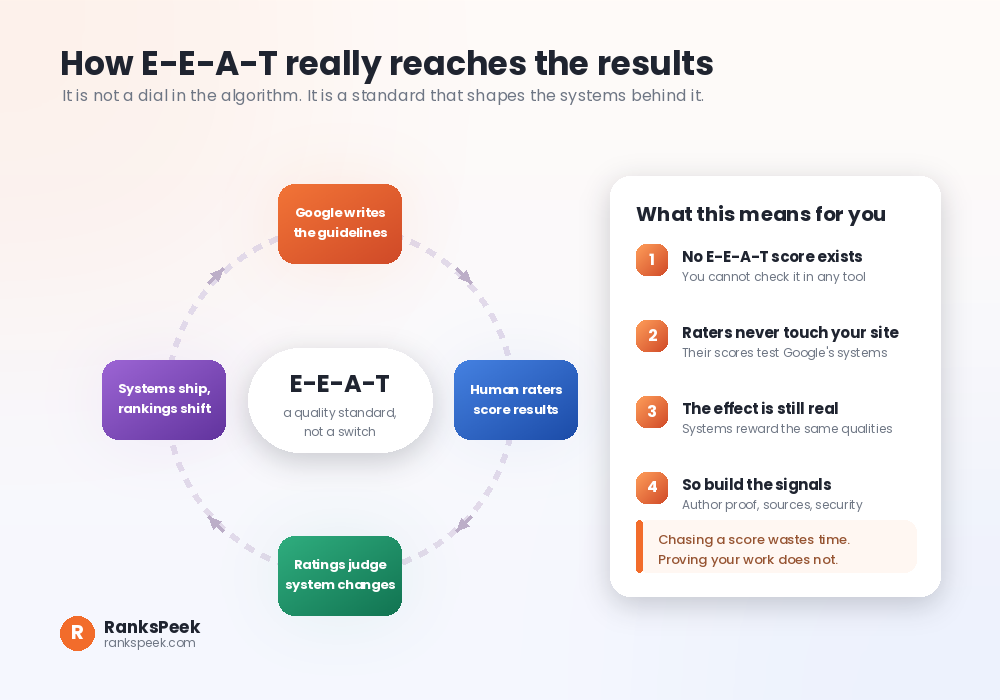
This part confuses many people, so let us be precise. Firstly, there is no E-E-A-T score inside Google. Secondly, raters do not visit your site and press a button that lifts your rankings. In truth their scores never touch your page directly.
Instead the loop works like this. Google writes the guidelines. Raters apply them to sample results. Those ratings then tell Google whether a proposed change made search better or worse. Finally, systems that pass the test go live for everyone.
So the effect is real, yet indirect. When people ask what is E-E-A-T in SEO, they often expect a dial. Chasing that imaginary score wastes your time. Meanwhile, building the qualities the guidelines describe does help, because Google’s systems aim at those same qualities.
Where E-E-A-T Matters Most: YMYL Pages
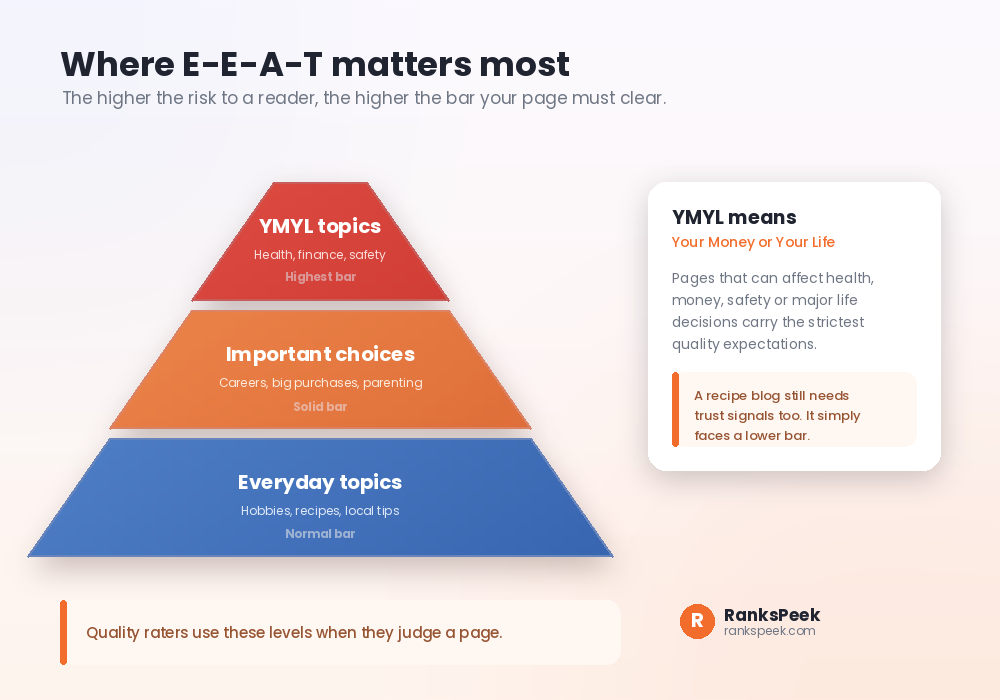
YMYL stands for Your Money or Your Life. Basically these are pages that could affect a reader’s health, finances, safety or major life decisions. Because the stakes are high, the quality bar climbs with them.
For example, a page about insulin dosing carries far more risk than a page about houseplants. Therefore Google expects far stronger signals on the first one. In that case medical reviewers, cited studies and named experts are not decoration. Rather, they are the minimum.
Even so, everyday topics still need trust. Of course your recipe blog will not need a licensed nutritionist. Still, it needs a real author, a working contact page and honest claims.
What Quality Raters Actually Check
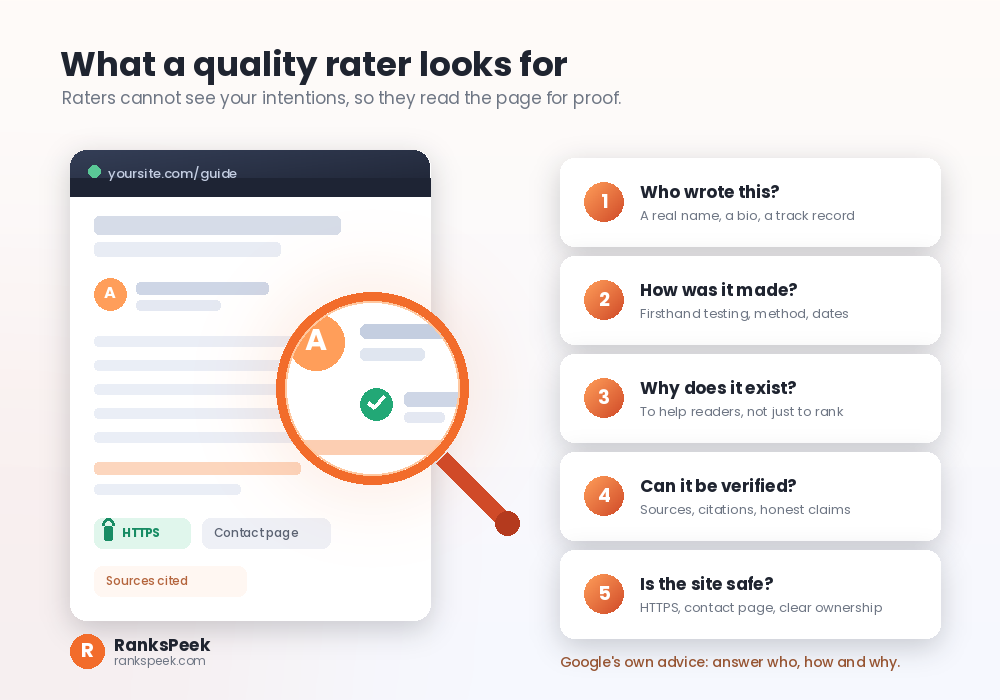
What is E-E-A-T in SEO from a rater’s desk? Firstly, raters cannot read your mind. Consequently they read your page, your author box, your about page and your site as a whole. Usefully, Google’s own advice for creators sits in three questions.
- Who created this? Firstly, can a reader find a real name, a bio and a track record?
- How was it created? Secondly, is there any sign of testing, method, dates or original research?
- Why does it exist? Thirdly, was this written to help a reader, or purely to catch a keyword?
Answer those three honestly and you have covered most of E-E-A-T already. In fact, the third question is where thin content usually dies.
What Is E-E-A-T in SEO in Practice? Proving Experience
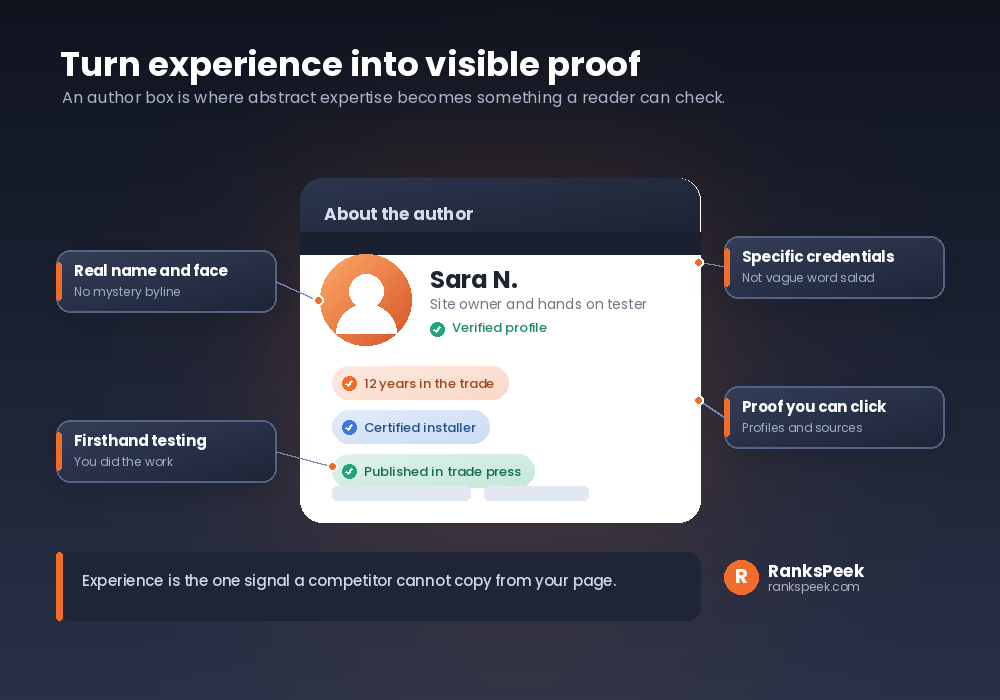
Here is where most sites lose easy points. Usually they have the experience. However, they never put it on the page.
So make it visible:
- Name the author. Firstly, add a real byline that links to a real bio page.
- State the credential that fits. Also keep it specific, since vague claims read as noise.
- Show the work. For example, add your own photos, screenshots or test notes.
- Date the page. Then update it when the facts move, and say what changed.
- Link your proof. Similarly, cite the sources you actually used.
- Own your mistakes. Publish corrections openly, because that builds more trust than pretending.
Notably, experience is the one signal a competitor cannot copy. They can rewrite your words. They cannot copy the afternoon you spent breaking the thing and fixing it again.
What Is E-E-A-T in SEO for AI Content?
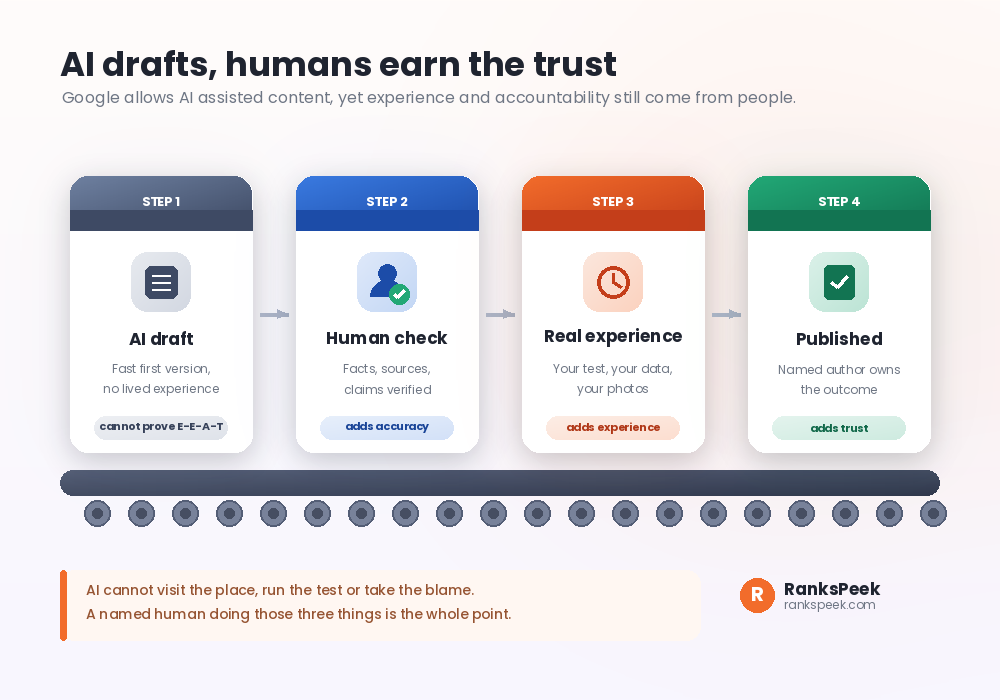
AI tools write quickly. Yet they cannot visit the workshop, taste the food, or lose a weekend to a broken plugin. Therefore they cannot supply experience, which is the letter Google added most recently.
Google’s position is reasonable. Basically, automation is allowed. Content built mainly to game rankings is not, whoever or whatever produced it. So the safe path is simple. Use AI as an assistant, then add the things only you can add.
| Signal | Can AI supply it alone? | What closes the gap |
|---|---|---|
| Experience | No | Your tests, photos and results |
| Expertise | Partly | A named human who checks every claim |
| Authoritativeness | No | Citations and mentions others give you |
| Trust | No | Accuracy, sources, security, accountability |
In short, a draft is not a page. Review it, correct it, sign it, and only then publish it.
What Is E-E-A-T in SEO Best Practice? Improve It Step by Step
Work in this order, because the early steps make the later ones believable.
- Fix trust first. Firstly, add HTTPS, a contact page, an about page and clear ownership details.
- Give every post an author. Then link that byline to a bio with real credentials.
- Add firsthand proof. Next, include your own images, data or test notes on your best pages.
- Cite honest sources. Also link to primary documentation rather than to a competitor’s summary.
- Cut the filler. Meanwhile, delete pages that exist only for a keyword, since they drag the whole site down.
- Update the important pages. Subsequently, review dates, prices and facts on a schedule.
- Earn mentions slowly. Consequently, focus on being worth citing rather than on buying links.
- Watch the basics. Finally, keep the site fast and crawlable, as we cover in why your WordPress site is slow.
Two more habits help. Firstly, keep your spam signals clean, and our guide on how to reduce spam score walks through that. Secondly, be patient, since trust compounds slowly, as explained in how long SEO takes to see results.
A Trust Lesson From Our Own Site
We build free SEO tools, so naturally we break things regularly. Here is one example, told plainly.
Once our blog pages showed up in Search Console as excluded by a noindex tag. Yet every setting looked correct. Firstly we checked the post settings. Secondly we checked the SEO plugin. Thirdly we checked the site wide visibility option. Surprisingly, all of them were fine.
Eventually we found the real cause. Our cache plugin kept serving an older copy of those pages, complete with an old noindex tag. Therefore we purged the cache, resubmitted the correct sitemap, and requested indexing. The next article appeared within a day.
Later, one tool page triggered a duplicate canonical warning. To clarify, the internal links, the sitemap and the canonical tag disagreed with each other. Once all three pointed at the same address, the warning cleared.
Why tell you this on a page about E-E-A-T? Because that is what experience looks like in writing. We are not quoting a manual. We are telling you what happened, what we tried, and what worked. So do the same on your own site, and your readers will feel the difference immediately.
E-E-A-T, AI Overviews and 2026
The answer to what is E-E-A-T in SEO does not change in 2026, although search keeps changing shape. Nowadays AI Overviews and other generated answers sit above the classic blue links, and assistants summarise pages before a reader ever clicks. Consequently, being the source that gets summarised matters more each year.
Nothing in that shift replaces E-E-A-T. Indeed, if anything, it raises the stakes. Machines can rewrite generic advice endlessly, so generic advice has almost no value left. Meanwhile, firsthand testing, named authors and verifiable sources become the scarce ingredients.
Therefore the 2026 playbook looks familiar. Publish things only you can publish. Make your identity obvious. Keep the page fast, clean and honest. For the wider view, read our take on whether SEO is dead or evolving in 2026 and our roundup of the latest SEO trends.
Frequently Asked Questions
What is E-E-A-T in SEO in simple words?
Basically it means proving four things on your page. Firstly, that you have done the thing. Secondly, that you understand it. Thirdly, that others treat you as a source. Finally, that your site is honest and safe to use.
Is E-E-A-T a Google ranking factor?
No, not directly. It is a set of guidelines for human quality raters. However, their ratings help Google test its ranking systems, so the same qualities tend to get rewarded anyway.
What does the extra E stand for?
Experience. Specifically, Google added it in December 2022, so the old E-A-T became E-E-A-T. In short, firsthand knowledge now sits beside formal expertise.
What is E-E-A-T in SEO for a small blog?
The same idea, at a smaller scale. Firstly add a real author box. Then show your own photos and results. Also keep your claims honest. Small sites often win here, because their experience is genuine.
Can AI written content have good E-E-A-T?
Partly. Certainly AI can help with structure and drafting. Still, it cannot supply lived experience or accountability, so a named human must add the proof and check every claim before publishing.
How do I measure my E-E-A-T?
You cannot, at least not as a number, because no such score exists. Instead audit the signals. Check your author pages, your sources, your security and your reputation, then fix the weakest one first.
Final Thoughts
So what is E-E-A-T in SEO, once the jargon falls away? It is Google asking a fair question on behalf of readers. Why should anyone believe this page? Answer that with real experience, honest sourcing and a name you are willing to attach, and you are most of the way there. Start with our free SEO Checker to spot the technical gaps, then fix the human ones yourself.