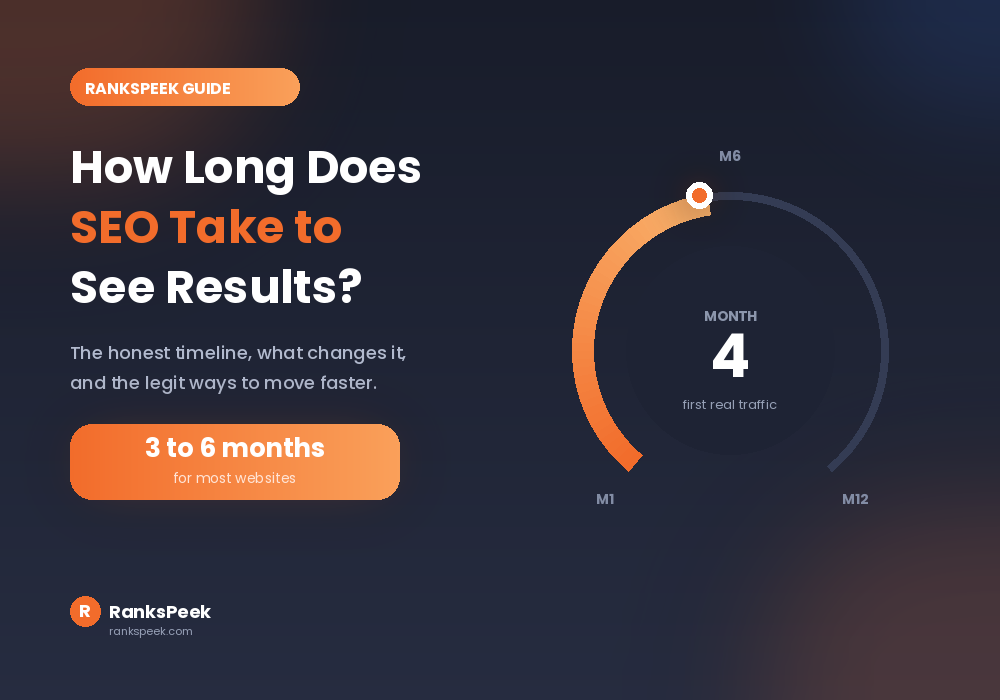
You fixed your pages, published good content, and waited. Nothing moved. So how long does SEO take to see results, really? For most websites, the honest answer is three to six months for early movement, and closer to a year for a brand new site. This guide breaks down why it takes that long, what changes your personal timeline, a realistic month by month roadmap, and the legitimate ways to speed it up.
Most websites see the first real movement in three to six months. New domains often need six to twelve months, because Google needs time to trust them. Google itself says businesses should expect four months to a year before improvements show a benefit. Long-tail keywords move fastest, while competitive terms take the longest.
How Long Does SEO Take to See Results? The Realistic Answer
Three to six months for first movement. That is the range most site owners actually experience. However, the range hides a lot, so here is the fuller picture.
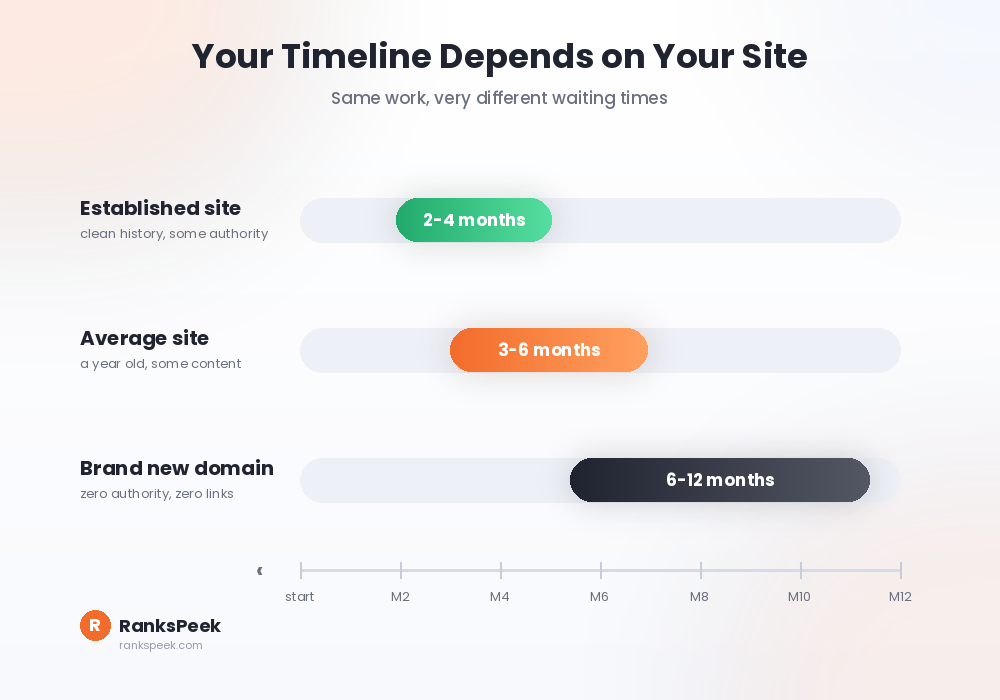
An established site with existing authority can move within weeks on easy keywords. A brand new domain usually waits six to twelve months, because Google needs time to discover it, trust it, and understand where it belongs. Google’s own guidance on working with an SEO puts the window at four months to a year before improvements show a real benefit. So if someone promises page one in thirty days, walk away.
Why SEO Takes So Long
SEO is not a switch. It is a trust-building process, and three separate clocks run at once.
First, the discovery clock. Google must crawl your pages, index them, and understand them. That alone can take days or weeks for a new site. Check whether your pages made it in with our free Google Indexed Pages Checker, because nothing else matters until they do.
Second, the evaluation clock. Google watches how people react to your pages. Do they stay? Do they come back? That data accumulates slowly. Third, the authority clock. Links and mentions arrive over months, not days, and they compound rather than spike. Consequently, real SEO gains arrive like interest on savings, not like a lottery win.
What Changes Your Personal Timeline
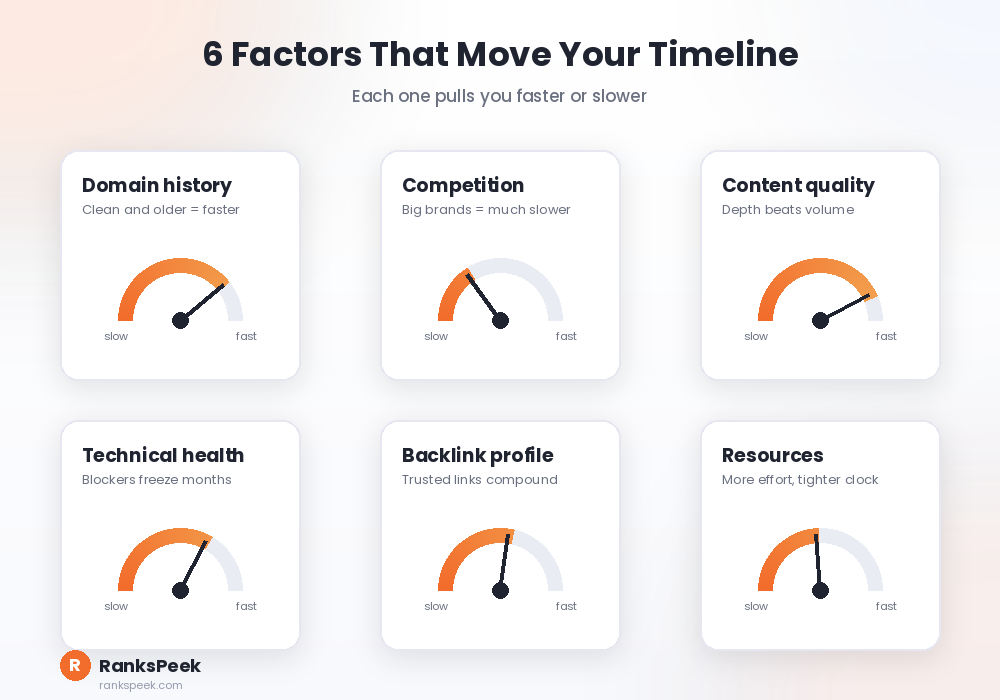
Six factors decide whether you land at the fast end of the range or the slow end. Your domain history matters most at the start: a clean older site moves faster than a fresh one, and a previously penalised domain moves slowest of all. Check any domain with our Domain Age Checker and its Spam Score before you blame your strategy.
Competition comes next. A long-tail question with weak rivals can rank in weeks, while a commercial keyword owned by big brands can take a year or more. Content quality follows, since thin pages simply never climb. Additionally, your technical health, your backlink profile, and the resources you can commit all pull the timeline in one direction or the other.
A Realistic Month by Month Roadmap
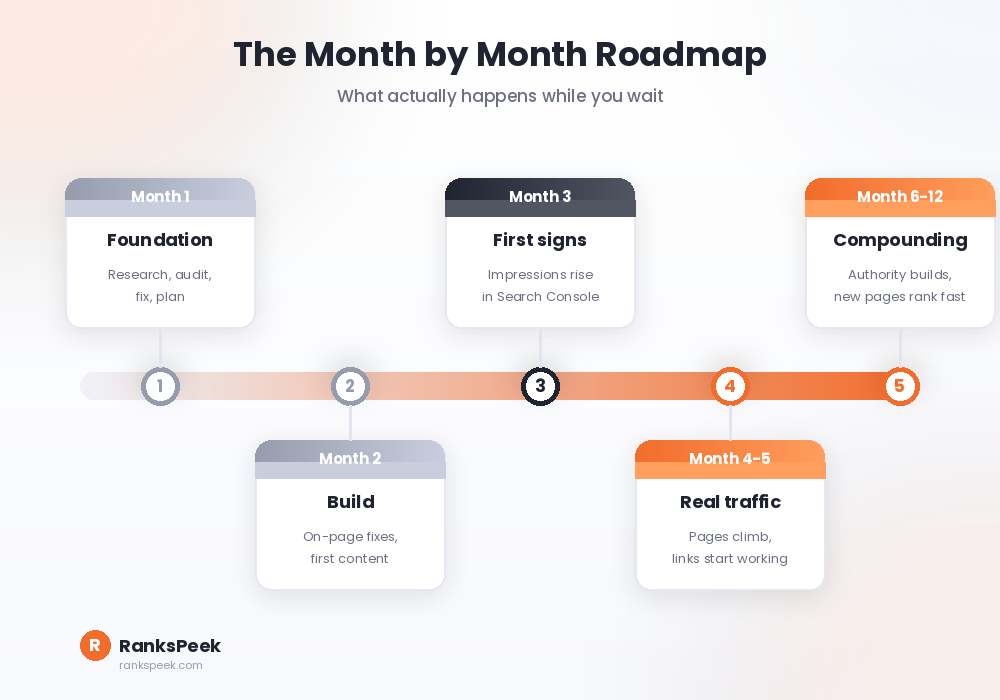
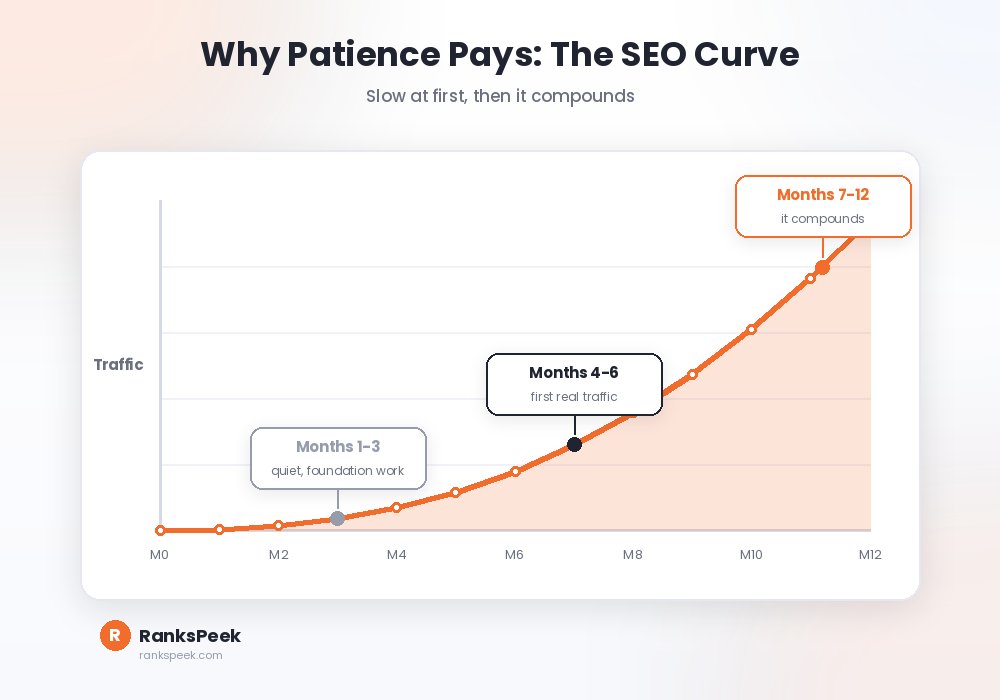
Month one is foundation. You research keywords, audit the site, fix what is broken, and plan content. Nothing visible happens yet, and that is normal. Run a full scan with our SEO Checker in this phase.
Month two is repair and build. You fix on-page issues, improve speed, and publish your first strategic pages. Month three brings the first flickers: impressions rise in Search Console, and long-tail pages start appearing on later pages of the results.
Months four and five deliver the first real traffic. Early pages climb, some reach page one, and you learn which topics your audience actually wants. Meanwhile, link building starts working. Months six to twelve are where compounding happens. Authority builds, older articles gain strength, and new pages rank faster than your first ones did. That acceleration is the real reward of patience.
How to Get SEO Results Faster
You cannot skip the clock, but you can stop wasting it. First, speed up discovery. Submit your sitemap in Search Console and request indexing for important URLs. Generate a clean sitemap with our free Sitemap Generator.
Second, chase long-tail keywords first. They face less competition, so they rank sooner and bring buyers rather than browsers. Find them with our Long Tail Keyword Research tool. Third, fix technical blockers immediately, because a noindex tag or a slow server can freeze your progress for months. Our guide on why a website is not showing up on Google covers every common blocker.
Fourth, focus your effort. Most of your results will come from a small share of your work, which is exactly what our guide on the 80 20 rule of SEO explains. Finally, publish consistently instead of in bursts, since steady output compounds while stop-start effort resets your momentum.
What Changed in 2026
Two shifts matter this year. Indexing became stricter for thin sites, because Google now judges overall quality before spending crawl budget. Consequently, a new site with ten strong pages gets indexed faster than one with a hundred shallow ones. Quality first genuinely shortens your timeline now.
Additionally, AI Overviews changed what early wins look like. Broad informational keywords bring fewer clicks than they used to, while specific, intent-driven pages still deliver. So the fastest path in 2026 runs through focused, experience-rich content rather than broad topic coverage. Same clock, smarter route.
Frequently Asked Questions
How long does SEO take to see results for a new website?
Usually six to twelve months for meaningful traffic. New domains start with no authority, so Google needs time to trust them. However, easy long-tail pages can appear within two to three months if they are indexed quickly.
Can SEO work in one month?
Rarely, and only in specific cases. Fixing a noindex tag, a broken sitemap, or a technical blocker can restore rankings within days. Building new rankings from nothing in a month is not realistic.
Why is my SEO not working after six months?
Usually one of four reasons: your pages are not indexed, your content misses search intent, your competition is far stronger, or your site has technical problems. Diagnose before doing more work, since more effort on the wrong problem changes nothing.
Does paying more make SEO faster?
Somewhat, but not proportionally. A bigger budget buys more content and outreach, which compresses the timeline. It cannot buy trust, and no budget removes Google’s evaluation period.
How do I track SEO progress while waiting?
Watch impressions and average position in Search Console, not just clicks. Those move first, months before traffic does. Additionally, track your authority monthly with our DA PA DR Checker to see your link growth.
So how long does SEO take to see results? Three to six months for most sites, longer for new ones, and faster only if you remove the blockers. Start by scanning your site with our free SEO Checker, then explore all 17 free tools on RanksPeek to make every month count.
The RanksPeek Team builds free SEO tools that help website owners check authority, backlinks, keywords, speed and more, with no signup needed. Explore all 17 free tools →