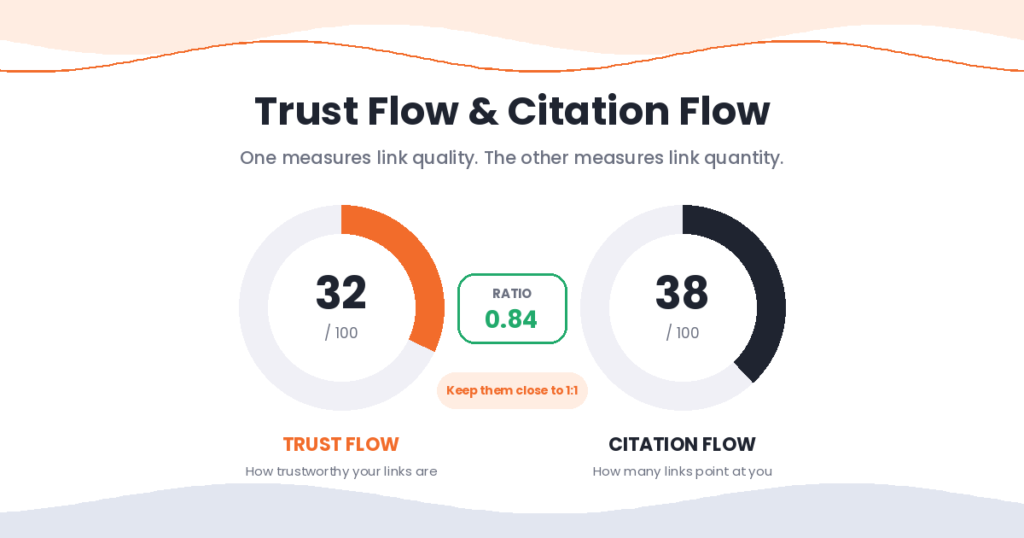
Two little numbers confuse almost every new SEO learner. So what is trust flow and citation flow in SEO, and why do the two scores rarely match? In short, one measures the quality of your backlinks, and the other measures their quantity. This guide explains both metrics in plain language. You will learn what good scores look like, how the famous ratio works, and how to improve both numbers for free.
Trust Flow and Citation Flow are backlink metrics created by Majestic, both scored 0 to 100. Trust Flow measures backlink quality, based on how close your links sit to a set of trusted seed sites. Citation Flow measures backlink quantity and link power. A healthy site keeps the two scores close together, ideally near a 1:1 ratio.
What Is Trust Flow?
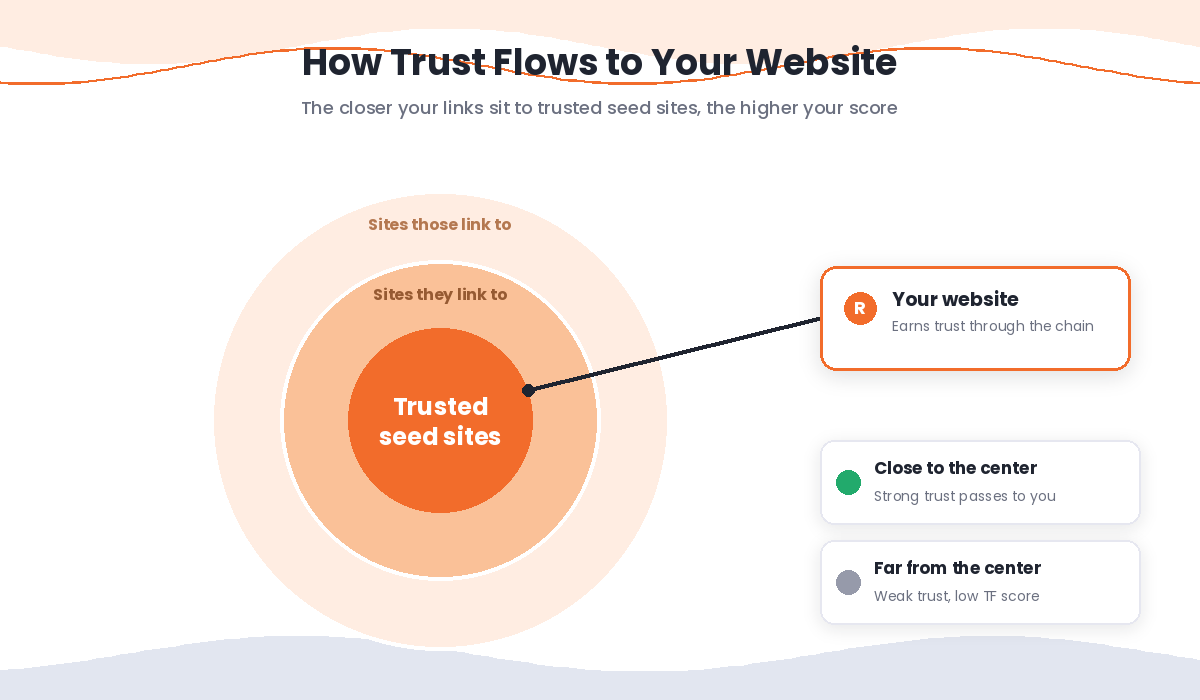
Trust Flow (TF) is a metric from Majestic that scores backlink quality from 0 to 100. The idea behind it is simple. Majestic maintains a list of highly trusted seed sites, reviewed by real people. Trust then flows outward through links. So the closer your backlinks sit to those trusted sites, the higher your score climbs.
For example, a link from a respected news site passes strong trust to you. Meanwhile, a link from a spammy directory passes almost none. Consequently, two sites with the same number of links can have very different Trust Flow scores. Quality decides everything here, not volume.
What Is Citation Flow?
Citation Flow (CF) is the sister metric, also scored 0 to 100. It measures the quantity and raw link power pointing at your site. More links generally mean a higher score. However, CF does not care whether those links come from trusted places. It simply counts influence flowing through the link graph.
That difference creates an important weakness. A site can inflate Citation Flow with hundreds of cheap, spammy links. The number rises, yet the site earns no real trust. Therefore, CF alone can mislead you. It only becomes useful next to Trust Flow.
Trust Flow and Citation Flow: The Real Difference
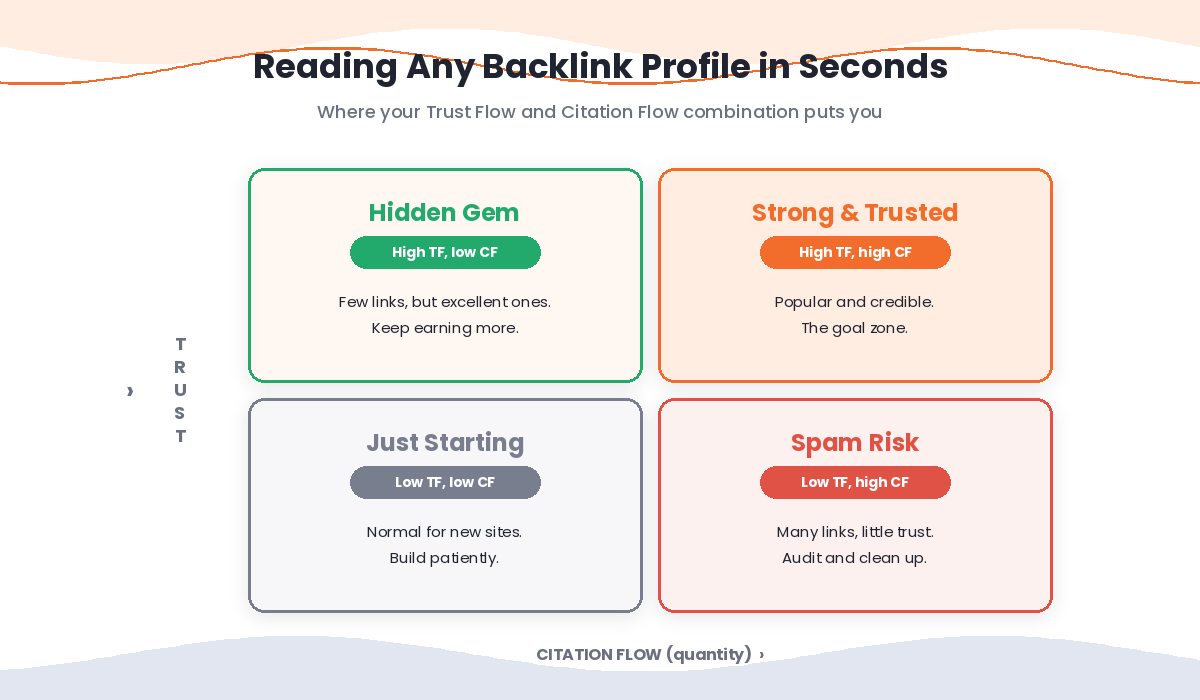
Here is the cleanest way to separate the two. Citation Flow asks: how many sites point at you, and how much link power do they carry? Trust Flow asks: how trustworthy are those sites? One counts the votes. The other checks who is voting.
Think of a scientist whose papers get cited constantly. High citations look impressive. But if unreliable sources produce most of those citations, the recognition means little. Similarly, a website drowning in low-quality links can show a big CF and a tiny TF. When you understand trust flow and citation flow together, you can read any backlink profile in seconds.
The TF to CF Ratio: The Number That Matters Most
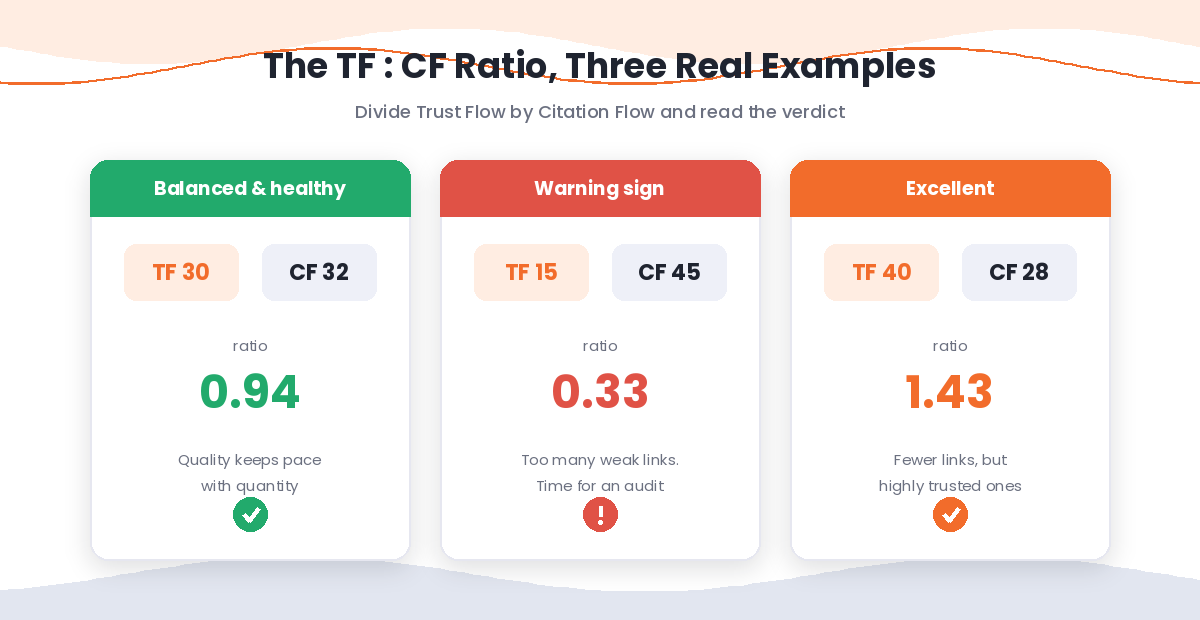
Individually, both scores tell half a story. The ratio between them completes it. Divide Trust Flow by Citation Flow. A result close to 1.0 means your links are both plentiful and trustworthy. That is the healthy zone.
However, a low ratio warns you. If your CF is 40 and your TF is 12, the ratio is 0.3. In other words, you have many links but little trust behind them. That pattern often points to spammy link building. On the other hand, a TF higher than CF is a good sign. It means fewer links, but high-quality ones.
What Are Good Trust Flow and Citation Flow Scores?
Most normal websites sit between 10 and 50 on both metrics. New sites usually start below 10, because trust takes time to earn. Scores above 50 belong to well-known brands and major publishers. So for a small or growing site, a TF between 10 and 30 with a balanced ratio is a solid position.
Want to see your numbers right now? Check any domain with our free Trust Flow / Citation Flow Checker. Then test a few competitors too. As with every authority metric, your niche sets the real benchmark, not a universal number. The same logic applies to DA, which we covered in our guide on what is a good domain authority for a new website.
Do These Metrics Affect Google Rankings?
No, and this point deserves honesty. Google does not use Trust Flow or Citation Flow. Majestic created both as third-party indicators. They estimate link quality from the outside. However, the things they measure, genuine links from trusted sites, do matter to Google’s own systems. Google’s spam policies make that clear, especially around link schemes.
So treat these scores like a thermometer. The thermometer does not cause the fever. It just reveals it. Similarly, a poor TF to CF ratio does not hurt your rankings directly. It reveals a link profile that probably will.
How to Improve Both Scores
Improving Trust Flow starts with earning links from genuinely trusted places. Industry blogs, local news, suppliers, and professional associations all count. Additionally, clean up the junk. Review your profile with our free Backlink Checker and identify spammy sources. If your profile carries a lot of toxic links, our guide on how to reduce spam score walks through the full cleanup.
Citation Flow grows more easily, because volume rises with any link building. So the smart move is to grow both together. Publish content worth citing. Then promote it to relevant sites, not random ones. Meanwhile, use internal links wisely, since trust also flows between your own pages. Finally, track your progress monthly with the DA PA DR Checker alongside your TF and CF numbers.
What Changed in 2026
Link quality signals matter more than ever this year. Google’s spam systems now discount manipulative links faster, so profiles built on purchased packages lose value quickly. As a result, the gap between a balanced ratio and a bloated CF keeps widening. Sites with clean, trusted profiles hold their rankings through updates. Sites with inflated numbers wobble.
Additionally, AI Overviews favor sources with strong trust signals. Answer engines cite recognizable, credible sites. Therefore, the work that lifts Trust Flow, real mentions from real places, now pays a second dividend: more visibility inside AI answers.
Frequently Asked Questions
What is the difference between trust flow and citation flow?
Citation Flow measures how many links point at your site and how much power they carry. Trust Flow measures how trustworthy those linking sites are. Together, the pair shows whether your link profile is both big and clean.
What is a good TF to CF ratio?
Aim for a ratio close to 1:1, meaning the two scores sit near each other. A TF at half your CF or lower suggests low-quality links. A TF above your CF is excellent, because it means quality outweighs volume.
Is Trust Flow a Google ranking factor?
No. Majestic created it as an independent metric, and Google does not use it. However, it estimates something Google does care about: whether trustworthy sites link to you. So it stays useful as a diagnostic tool.
Why is my Citation Flow higher than my Trust Flow?
This is normal for most sites, because volume grows faster than trust. However, a very large gap signals too many weak links. Audit your backlinks, remove or disavow the worst sources, and focus new efforts on trusted sites.
How can I check trust flow and citation flow for free?
Use our free Trust Flow / Citation Flow Checker. Enter any domain and see both scores instantly, with no signup. Check your competitors too, since context gives the numbers meaning.
Now you know what trust flow and citation flow really tell you: quality on one side, quantity on the other, and the ratio in between. Check your scores with the free Trust Flow / Citation Flow Checker, then explore all 17 free tools on RanksPeek to keep your link profile clean and growing.
The RanksPeek Team builds free SEO tools that help website owners check authority, backlinks, keywords, speed and more, with no signup needed. Explore all 17 free tools →