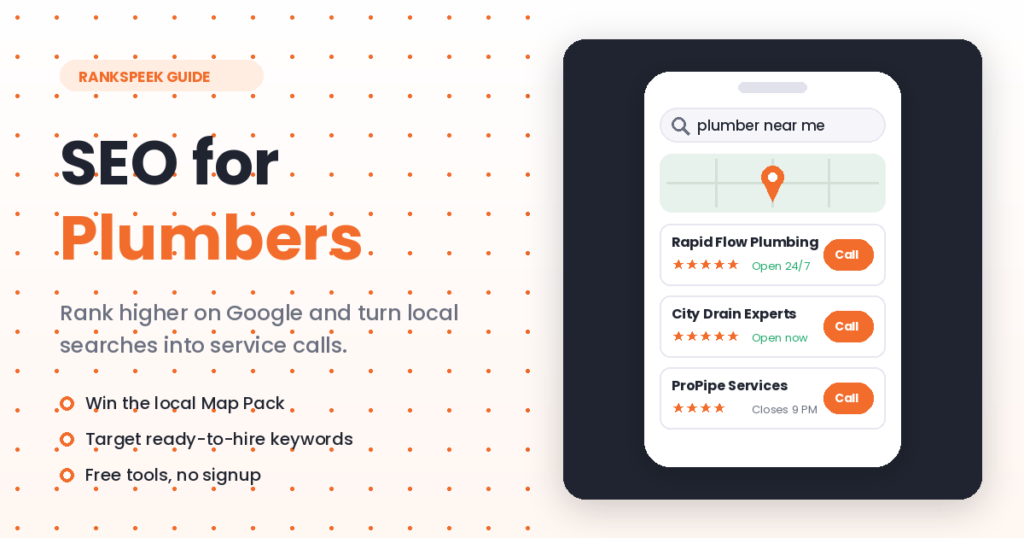
Most homeowners never plan to hire a plumber. Instead, they search for one in a panic when a pipe bursts or a water heater stops working. SEO for plumbers is how your business shows up at that exact moment, because ranking high on Google puts your phone number in front of people who are ready to call right now.
In this guide, you will learn how plumbing SEO works, which strategies matter most in 2026, and how you can start improving your rankings today using free tools.
SEO for plumbers is the process of optimizing a plumbing company’s website and Google Business Profile so it appears higher in local search results. The most important steps are claiming your Google Business Profile, collecting genuine reviews, targeting local keywords, and running a fast, mobile friendly website.
What Is SEO for Plumbers?
SEO for plumbers is a set of practices that help a plumbing website rank higher on Google and other search engines. In simple terms, it makes your business easier to find when local customers search for services like drain cleaning, water heater repair, or emergency plumbing.
Plumbing SEO covers five connected areas. First, local SEO puts your business on the map through your Google Business Profile. Second, on-page SEO shapes your titles and service pages around the words customers type. Third, technical SEO keeps your site fast and crawlable. Fourth, content marketing answers the questions homeowners search for. Finally, link building earns mentions from trusted websites.
Before you change anything, it helps to know where you stand. So run your website through our free SEO Checker to spot missing titles, weak meta tags, and other quick wins in seconds.
Why SEO for Plumbers Matters in 2026
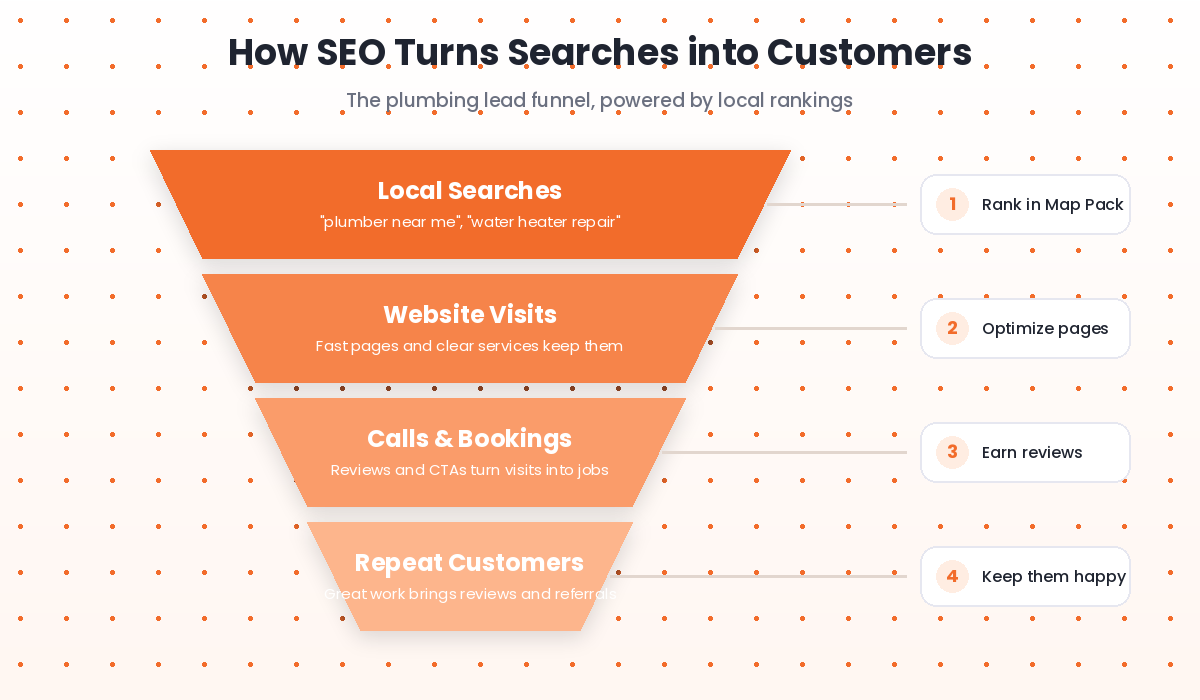
Plumbing is an emergency-driven business. When a kitchen sink backs up before guests arrive, people grab their phones and search for a plumber near them. As a result, the companies at the top of those results get the call, while everyone else gets skipped.
Paid ads can put you at the top too, but the clicks stop the moment your budget runs out. Organic rankings work differently, because a well optimized site keeps bringing in leads month after month without a per-click cost. In fact, for most local service businesses, organic search becomes their cheapest source of qualified leads over time.
There is also a trust factor, because many searchers skip the ads on purpose and click the organic results instead. Therefore, strong rankings bring traffic and build credibility at the same time.
Local SEO: How to Win the Map Pack
When someone searches for a plumber in their city, Google usually shows a map with three local businesses above the regular results. This block, often called the Map Pack, is the most valuable real estate for any plumbing company. So your first priority should be earning a spot there.
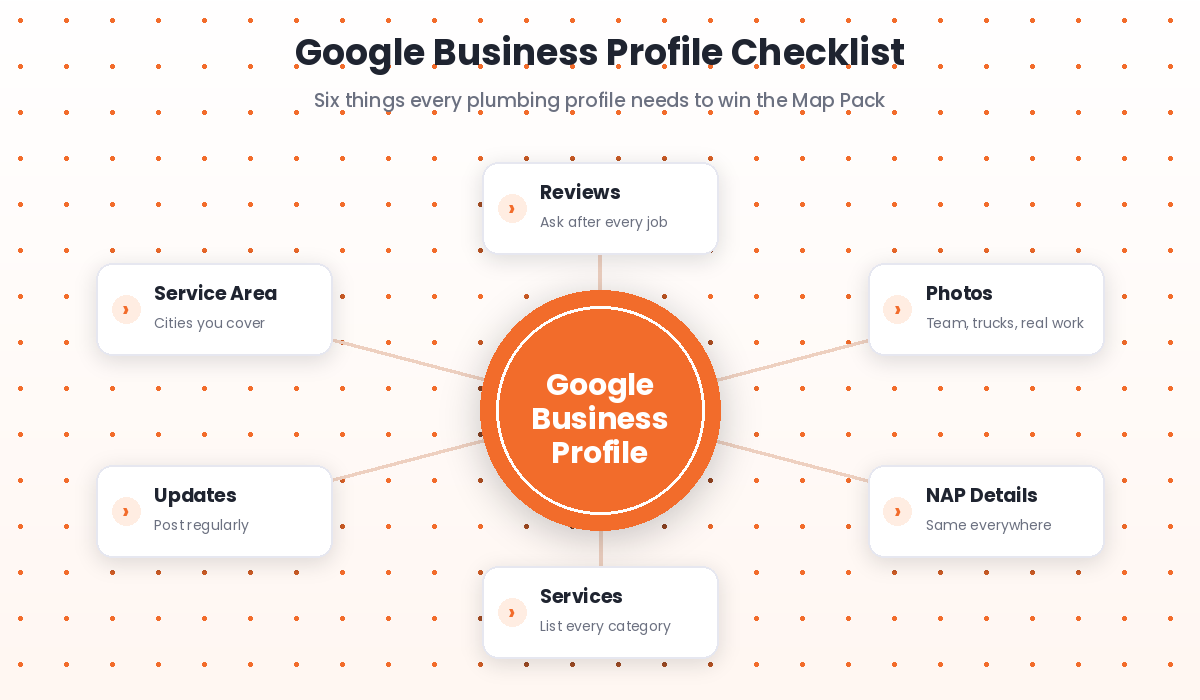
Start by claiming your free Google Business Profile. Then fill in every field carefully: business name, address, phone number, hours, services, and service areas. Consistency matters, because Google compares these details across the web. If your address differs between your website, your profile, and local directories, Google trusts you less.
Next, add real photos of your team, your trucks, and your work. Additionally, post short updates regularly, since an active profile signals a living business. Google explains how these factors shape local rankings in its guide to improving your local ranking, and it is worth reading once.
Keyword Research for Plumbing Services
Keyword research tells you what customers type before they hire. For plumbers, the most valuable terms usually combine a service with a location, for example “water heater repair in Dallas” or “emergency plumber near me”. These searches show clear intent to hire, so they deserve their own optimized pages.
However, do not stop at the obvious terms. Homeowners also search questions like “why is my water heater leaking” long before they call anyone. If your blog answers those questions helpfully, you meet customers early and earn their trust first.
You can build your keyword list for free. First, drop a seed term like “drain cleaning” into our Keyword Generator to collect related ideas. Then use the Long Tail Keyword Research tool to find longer, low competition phrases that new plumbing sites can actually rank for.
On-Page SEO and Content That Converts
On-page SEO means placing your keywords where they matter most. Your title tag should include the main service and city in under 60 characters. Similarly, your meta description should summarize the page in under 160 characters with a reason to click. Our free Meta Tags Analyzer shows you exactly what Google sees on any page, so check your key pages first.
Structure matters too. Every service deserves its own page with a unique H1, clear subheadings, and descriptive image alt text. Likewise, every city you serve deserves a unique location page, not a copied one, because duplicate content weakens rankings.
When you write, aim for natural language rather than stuffing. Also, you can paste any page into our Keyword Density Checker to confirm your target phrase appears often enough without crossing into spam territory.
Technical SEO Basics Every Plumber Needs
Technical SEO sounds intimidating, yet the basics are simple. Your site must load fast, work on phones, and stay easy for Google to crawl, because a slow site loses emergency visitors within seconds.
Test your speed with our PageSpeed Insights tool, which grades your site on the same Core Web Vitals metrics Google uses. Compress oversized images, remove unused plugins, and use caching if your scores come back low.
Also, make sure Google can find every important page. Generate a clean XML sitemap with our Sitemap Generator, then submit it in Google Search Console. Consequently, new service pages get discovered and indexed much faster.
Reviews, Citations, and Backlinks
Reviews are ranking fuel for local businesses, because Google counts prominence as a local ranking factor and reviews feed directly into it. So ask every satisfied customer for a review, ideally right after the job. Make it easy too, for example with a direct review link in your invoice or a QR code on your business card.
Beyond reviews, citations help. A citation is any listing of your business name, address, and phone number on directories and local websites. Keep those details identical everywhere, because consistency builds trust with search engines.
Backlinks from relevant sites raise your authority as well. Home improvement blogs, local news sites, and supplier pages are all realistic targets for a plumbing business. You can measure your progress with our DA PA DR Checker and review who links to you with the Backlink Checker.
What Changed for Plumbing SEO in 2026
Search looks different in 2026, and SEO for plumbers has shifted with it. The biggest change is AI Overviews, the AI generated answers Google now shows above many results. To appear in them, structure your content around direct answers: short definition style paragraphs, clear FAQ sections, and honest, specific information.
Voice search keeps growing too, since many homeowners now ask their phone or speaker to find a plumber. Meanwhile, Google keeps rewarding content that shows real experience, so photos of actual jobs and first hand tips matter more than generic filler.
None of this replaces the fundamentals. Fast site, complete Google Business Profile, steady reviews, helpful content. The plumbing companies that keep doing these basics consistently are the ones winning in 2026.
Frequently Asked Questions
How long does SEO for plumbers take to work?
Most plumbing websites see early movement within two to three months, while stronger results usually arrive between six and twelve months. However, local improvements like new reviews often show impact faster.
Can I do plumbing SEO myself?
Yes, absolutely. The core tasks need consistency more than technical skill, and free tools handle the analysis. So start with an audit and fix one issue at a time.
How much does plumbing SEO cost?
Doing it yourself costs only time, because tools like the ones on RanksPeek are free. However, hiring an agency typically runs a few hundred to a few thousand dollars per month, depending on your competition.
What keywords should a plumber target first?
Start with service plus city combinations, for example “drain cleaning in [your city]”, since these carry clear hiring intent. Then add question keywords for your blog to reach homeowners who are still researching.
Do reviews really affect plumbing SEO rankings?
Yes. Google lists prominence as a local ranking factor, and reviews feed into it directly. Additionally, a strong rating persuades searchers to pick you over competitors, so reviews improve both rankings and conversions.
Ready to see how your plumbing website measures up? Run it through our free SEO Checker and get an instant action list, or explore all 17 free tools on RanksPeek to start climbing the rankings today.
The RanksPeek Team builds free SEO tools that help website owners check authority, backlinks, keywords, speed and more, with no signup needed. Explore all 17 free tools →