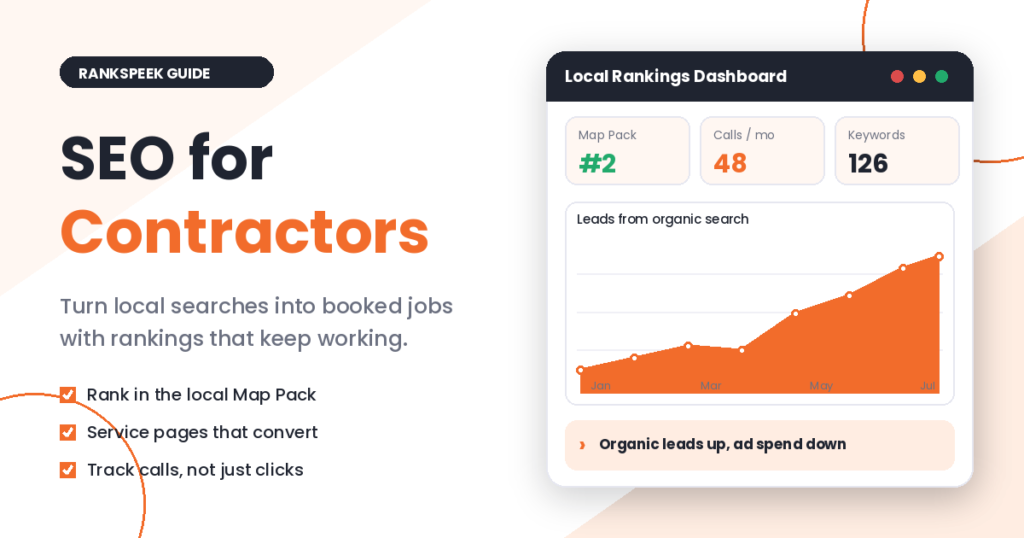
Word of mouth built your contracting business, but word of mouth alone cannot fill next month’s schedule. SEO for contractors changes that, because it puts your company in front of homeowners at the exact moment they search for someone to hire. In this guide, you will learn a practical, step by step approach that works for general contractors, remodelers, roofers, and every trade in between.
SEO for contractors is the process of optimizing a contracting company’s website and Google Business Profile so it ranks higher when local customers search for services like remodeling, roofing, or new construction. The core steps are optimizing your local profiles, targeting the right keywords, building fast service pages, and earning reviews and backlinks.
What Is SEO for Contractors?
SEO for contractors is a set of techniques that help a contracting website appear higher on Google when nearby customers search for your services. Because most contracting work is local, the biggest wins come from local search: the map with three businesses that Google shows for searches like “kitchen remodeler near me”. That block, known as the Map Pack, sends ready-to-hire customers straight to your phone.
However, the Map Pack is only one piece. A complete strategy also covers your website content, your page speed, your keywords, and the links pointing to your site. So before you touch anything, get a baseline. Run your site through our free SEO Checker first, because it highlights the quick fixes in seconds.
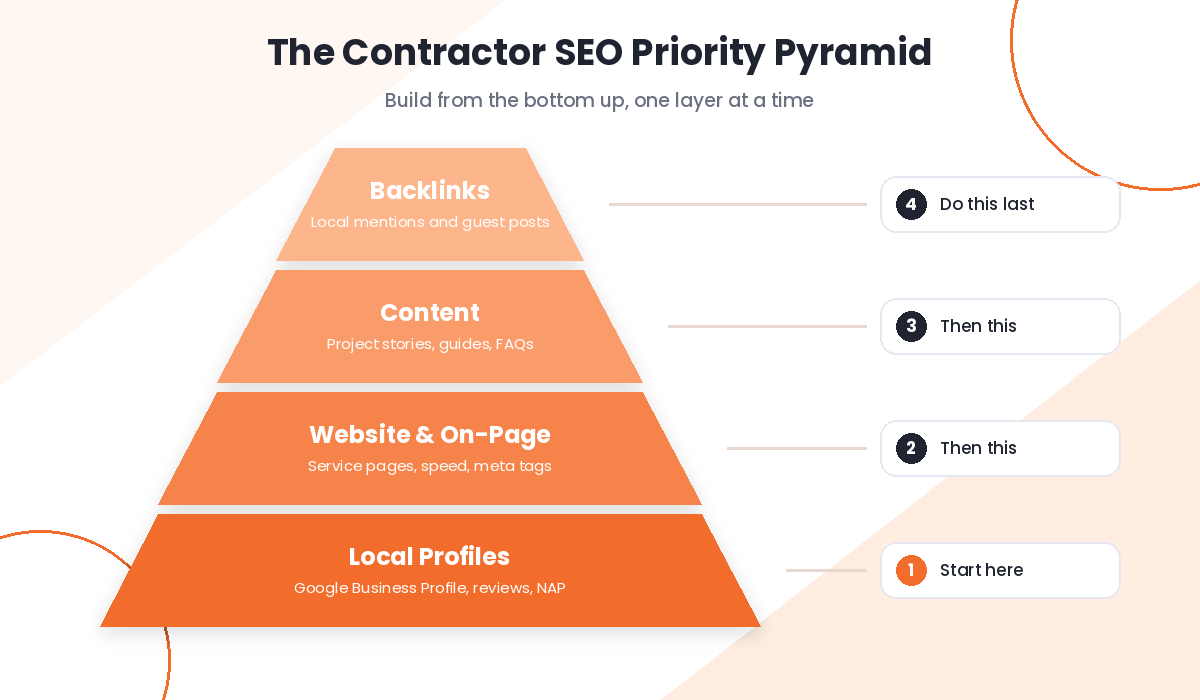
Step 1: Optimize Your Local Profiles
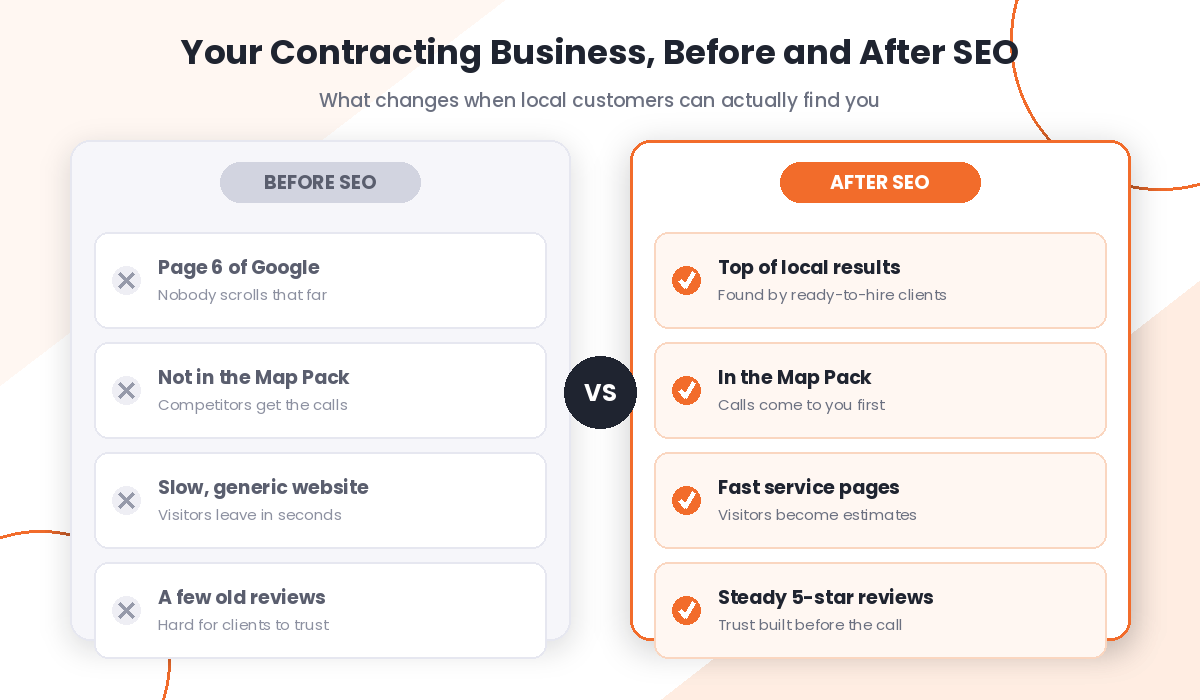
For contractors, local profiles deserve your attention before anything else. Start with a free Google Business Profile, then complete every single field: business name, address, phone number, hours, services, and photos of finished projects. Consistency is critical here, because Google cross-checks your name, address, and phone number across the whole web. Even a small mismatch, like “Ave” on one listing and “Avenue” on another, can weaken your rankings.
Next, list your business in trusted directories such as Yelp, Bing Places, and local trade associations. Additionally, build a steady flow of reviews. Ask right after you finish a job, hand clients a QR code that opens your review page, and reply to every review you receive. Reviews shape both your rankings and your reputation, so treat them as part of the job, not an afterthought.
Step 2: Do Targeted Keyword Research
Keywords are the exact phrases customers type before hiring. For contractors, the most valuable ones combine a service with a location, for example “bathroom remodel Austin” or “roof replacement near me”. These carry hiring intent, so each one deserves its own optimized page.
Meanwhile, informational searches like “how much does a kitchen remodel cost” happen much earlier in the customer journey. Answering them on your blog builds trust before your competitors even get a chance. As a result, when the homeowner is finally ready, your name is the one they remember.
Finding these phrases is free. First, enter a seed term like “home remodeling” into our Keyword Generator to collect ideas. Then run the same seed through the Long Tail Keyword Research tool, because longer phrases have less competition and rank faster for newer sites.
Step 3: Build a Fast, Optimized Website
Your website has one job: turn visitors into phone calls. Therefore, every service you offer needs its own page with a unique headline, clear photos of your work, and a visible call to action. If you serve multiple cities, create a separate page for each area too, and write unique content for every one instead of copying.
On-page SEO ties it together. Put your main keyword in the title tag (under 60 characters), the meta description (under 160 characters), and the page headline. Our Meta Tags Analyzer shows you exactly how any page looks to Google, so check your top pages today. Also, paste your service pages into the Keyword Density Checker to confirm your keywords appear naturally rather than stuffed.
Speed matters just as much, because slow pages lose impatient visitors. Test yours with our PageSpeed Insights tool, then compress heavy project photos, since oversized images are the most common cause of slow contractor sites. Finally, connect your pages with internal links and generate an XML sitemap using the Sitemap Generator so Google finds everything quickly.
Step 4: Create Content That Wins Jobs
Content is where contractors have an unfair advantage, because you have real projects to show. Before and after posts, project case studies, and honest cost guides all perform well. For example, a post walking through a real deck build, with photos and the problems you solved, proves your expertise better than any slogan.
Google’s own SEO starter guide stresses helpful, people-first content, and that advice fits contractors perfectly. So answer the questions clients actually ask: how long a remodel takes, what permits cost, how to choose a contractor. Then end each post with a simple next step, like a free estimate form.
Step 5: Build Backlinks and Authority
Backlinks are links from other websites to yours, and they work like referrals in Google’s eyes. Local links matter most for contractors. Consequently, aim for mentions in local news stories, community sponsorships, supplier directories, and home improvement blogs.
Guest posts help too, especially on real estate and home care websites where your expertise fits naturally. Also, search for existing mentions of your company that do not link to you yet, then politely ask the site owner to add the link. You can track your growing authority with our DA PA DR Checker and review new links in the Backlink Checker.
How to Measure Your Results
SEO without measurement is guesswork. Track four things every month: your rankings for target keywords, your organic traffic in Google Analytics, your indexed pages in Google Search Console, and most importantly, your calls and form submissions. Because leads pay the bills, they are the metric that matters in the end.
Give it time as well. Most contracting sites need three to six months before rankings move meaningfully, and that is normal. Consistent effort beats bursts of activity every single time.
What Changed for Contractor SEO in 2026
SEO for contractors looks a little different in 2026, mainly because of AI Overviews. Google now shows AI generated answers above many search results, and those answers pull from pages with clear, direct explanations. Therefore, structure your content with short answer paragraphs, FAQ sections, and specific details, since that format gets cited most often.
Additionally, Google keeps raising the bar on real experience. Original project photos, first hand cost breakdowns, and named team members now carry more weight than stock images and generic text. In short, the more your website looks like a real contractor’s work and less like a template, the better it performs.
Frequently Asked Questions
How long does SEO for contractors take?
Most contractor websites see early improvements within two to three months, while stronger rankings usually take six to twelve months. However, Google Business Profile updates and new reviews often show results faster.
What keywords should a contractor target first?
Begin with service plus city phrases, for example “kitchen remodeling in [your city]”, because these searches show clear hiring intent. Then add question keywords to your blog for homeowners who are still planning.
Is SEO better than paid ads for contractors?
They serve different goals. Ads bring instant visibility but stop the moment you stop paying, while SEO builds slowly and then keeps delivering leads without a per-click cost. Most established contractors use SEO as their long term foundation.
Can I do contractor SEO myself?
Yes. The essentials, like completing your Google Business Profile, collecting reviews, and writing service pages, need consistency more than technical skill. Free tools cover the analysis side, so start small and stay regular.
Do reviews affect contractor rankings?
Absolutely. Review count and rating feed into Google’s local ranking signals, and they also convince hesitant homeowners to pick you. So a review routine improves rankings and win rates together.
Ready to find out where your contracting site stands? Run it through our free SEO Checker for an instant report, or explore all 17 free tools on RanksPeek and start climbing local search today.
The RanksPeek Team builds free SEO tools that help website owners check authority, backlinks, keywords, speed and more, with no signup needed. Explore all 17 free tools →