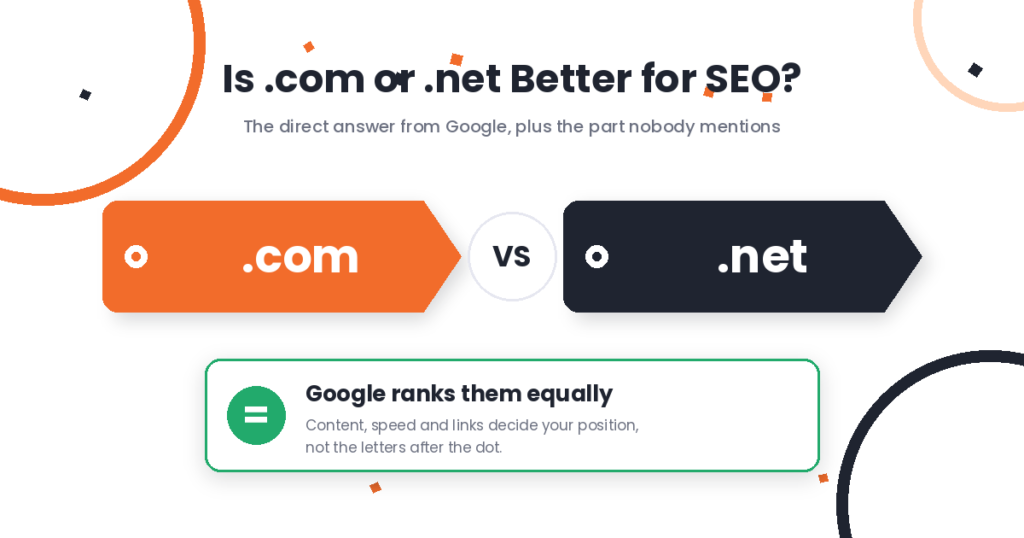
You found the perfect domain name, but the .com is taken and the .net is available. Now the big question: is .com or .net better for SEO? The honest answer might surprise you, because Google treats them exactly the same. However, the full story has a few twists worth knowing before you buy. This guide covers the direct answer, the indirect effects, and how to choose the right extension for your situation.
Neither. Google confirms that generic extensions like .com and .net rank equally, so your content, speed, and backlinks decide your position, not your extension. However, .com carries indirect advantages: people trust it more, remember it more easily, and type it by default. Pick .com when available, but never fear building on .net.
What Is a Domain Extension?
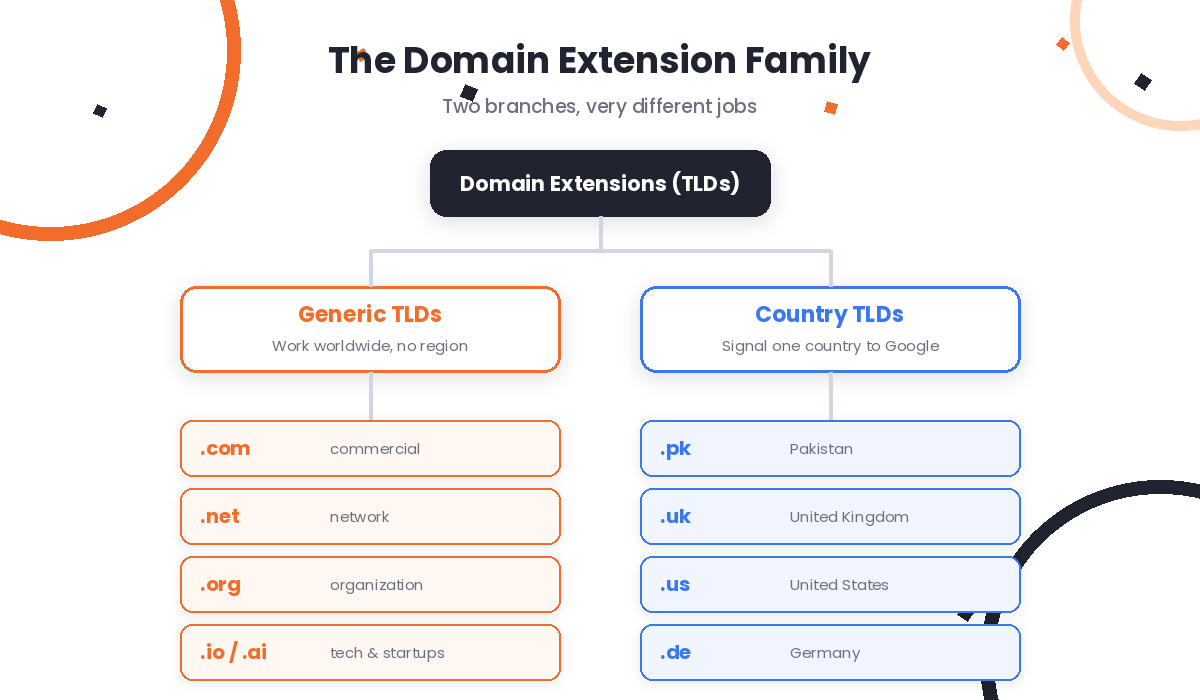
A domain extension, also called a TLD (Top-Level Domain), is the suffix at the end of a web address. In rankspeek.com, the extension is .com. Extensions come in two main families. Generic TLDs like .com, .net, and .org work worldwide without any regional meaning. Meanwhile, country code TLDs like .us, .uk, and .pk signal a specific country.
Originally, each extension had a purpose. The .com stood for commercial, and .net stood for network providers. However, those lines blurred decades ago. Today, anyone can register either one for any kind of website.
Is .com or .net Better for SEO? Google’s Answer
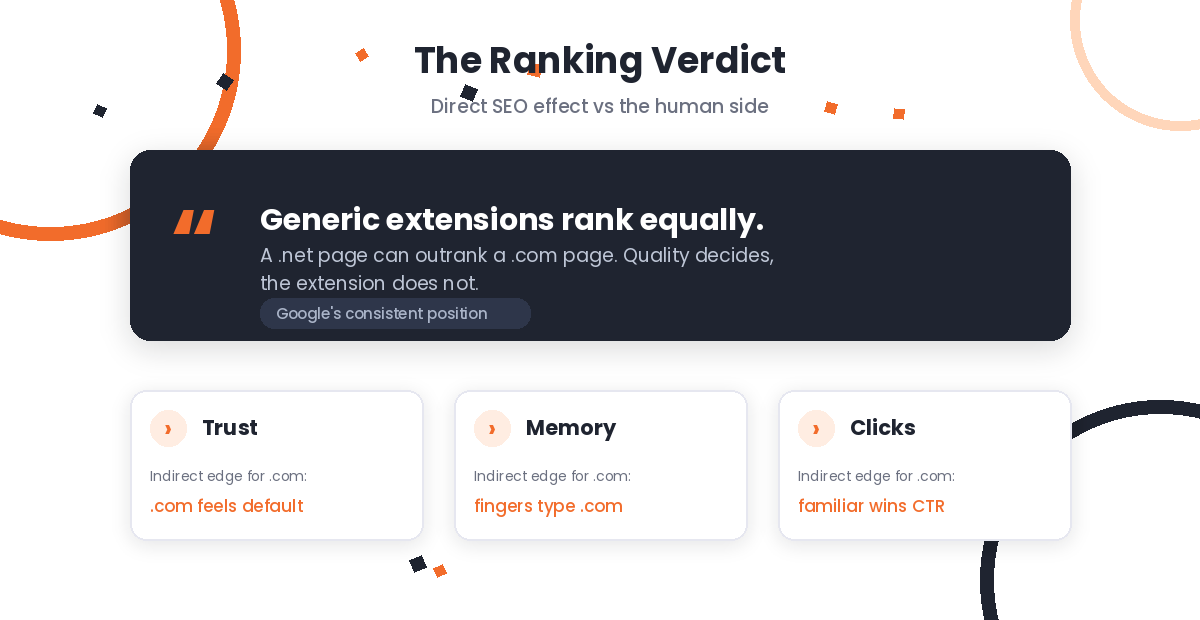
Here is the direct answer, straight from the source. Google has stated repeatedly that generic extensions receive equal treatment in ranking. A .net site can outrank a .com site, and it happens every day. The algorithm cares about your content quality, page speed, backlinks, and user experience. It does not award points for the letters after the dot.
So if someone tells you that switching from .net to .com will boost your rankings, they are wrong. The extension is not a ranking factor. Consequently, the question is .com or .net better for SEO has a boring technical answer: they tie. However, the practical answer has more layers, and those layers matter for your business.
Where .com Still Wins (Indirectly)
Rankings are only part of the game. People built habits around .com for thirty years, and those habits create three indirect advantages. First, trust: many users see .com as the default for a real business. Second, memorability: when someone recalls your site later, their fingers type .com automatically. If you own the .net, that muscle memory can send your visitors to a competitor.
Third, click-through rate. In search results, a familiar extension can earn slightly more clicks than an unusual one. More clicks mean more traffic from the same position. Therefore, .com wins the human side of the equation, even though it ties on the algorithm side.
When .net (or Another Extension) Makes Sense
Sometimes the .com is taken, parked at a crazy price, or attached to an old brand. In those cases, .net remains a completely respectable choice. Tech companies, tools, and networks use it comfortably. Additionally, a clean .net beats a hyphenated or misspelled .com every time, because awkward names hurt memorability more than any extension does.
One warning before you buy any domain: check its history. A previously owned domain can carry spam baggage from its past life. So run it through our free Domain Age Checker to see how old it is, then check its Spam Score and Domain Authority. Two minutes of checking can save you from buying someone else’s penalty.
Country Extensions and Local Targeting
Country code TLDs work differently, because they carry a real geo-targeting signal. A .pk domain tells Google your site targets Pakistan, and a .de domain points to Germany. For a strictly local business, that signal helps you rank in local results. Google explains this system in its multi-regional site documentation, and it is worth a read if you target one country.
However, the same signal becomes a limit if you want global traffic. A ccTLD ties you to one region, while a .com or .net stays neutral worldwide. So choose based on your real audience, not on what looks available.
What About .io, .ai, and the New Extensions in 2026?
Newer extensions exploded in popularity, especially .ai during the current AI boom. Good news: Google treats most of these like generic TLDs, so they rank on equal footing too. Startups build massive brands on .io and .ai every year.
Two cautions apply in 2026. First, some cheap extensions attracted heavy spam over the years, and users noticed. An unfamiliar extension can look suspicious in an email or ad, even though Google ranks it fine. Second, AI answer engines cite brands they recognize, so a clear, memorable name matters more than ever. The extension itself stays neutral; the brand you build on it does the work.
How to Choose: A Simple Decision Guide
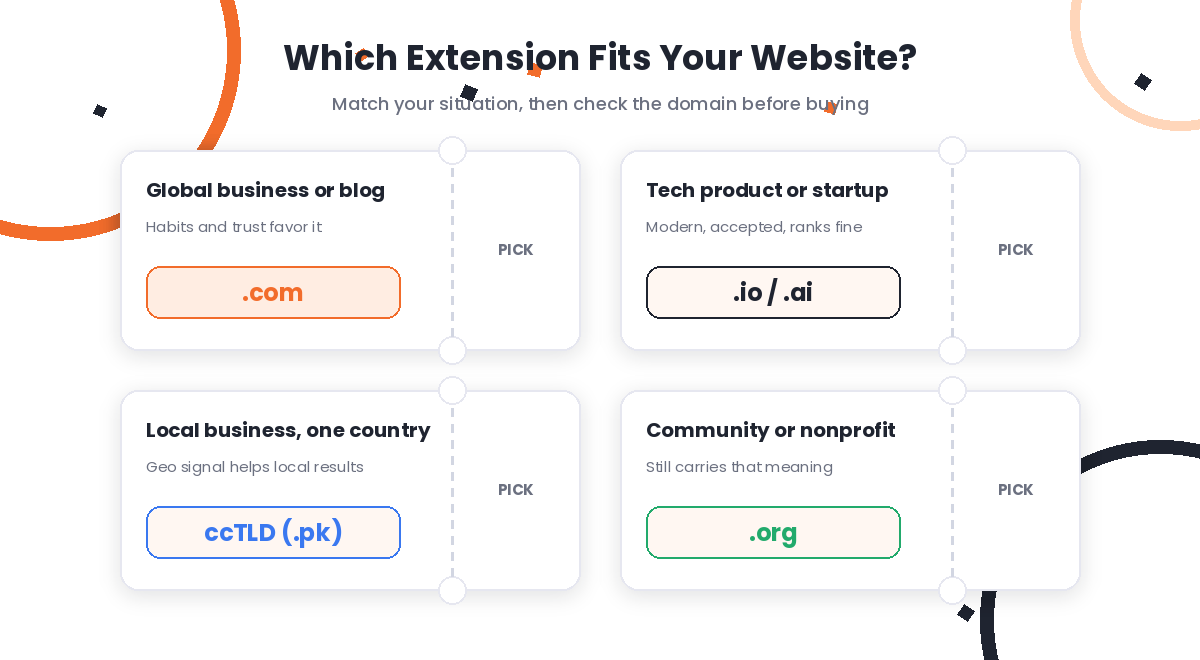
Global business or blog? Take the .com if available, because habits favor it. Tech product or tool? The .io, .ai, or .net all work well. Local business serving one country? Consider the ccTLD for the geo signal. Nonprofit? The .org still carries that meaning for many people.
Whatever you pick, the work after the purchase decides everything. Run your new site through our SEO Checker to nail the basics early. Then build authority patiently, exactly as we described in our guide on what is a good domain authority for a new website. The extension is your address. The content is your reputation.
Frequently Asked Questions
So, is .com or .net better for SEO in 2026?
They rank equally, because Google treats generic extensions the same. The .com wins only on human factors: trust, memory, and default typing habits. Pick .com when you can, and build confidently on .net when you cannot.
Will switching from .net to .com improve my rankings?
No, and the migration itself carries risk. Redirects can leak a little authority, and mistakes can cost traffic for months. Switch only for branding reasons, never for rankings.
Do keywords in a domain name help SEO?
Barely. Exact-match domains lost their power years ago. A short, memorable brand name beats a keyword-stuffed domain, because brands earn clicks and mentions over time.
Is an old domain better than a new one?
Age alone is not a ranking factor. However, an older domain may carry existing backlinks, good or bad. Check any domain’s age with our Domain Age Checker and inspect its link history before buying.
Are cheap extensions like .xyz bad for SEO?
Google ranks them equally, so no direct penalty exists. However, some carry a spammy reputation with users, which can lower trust and clicks. For a serious business, a mainstream extension usually pays for itself.
So the next time someone asks whether .com or .net ranks better, you know the answer: the extension ties, the execution decides. Check any domain before you buy with our free Domain Age Checker, then explore all 17 free tools on RanksPeek to build your new site right from day one.
The RanksPeek Team builds free SEO tools that help website owners check authority, backlinks, keywords, speed and more, with no signup needed. Explore all 17 free tools →