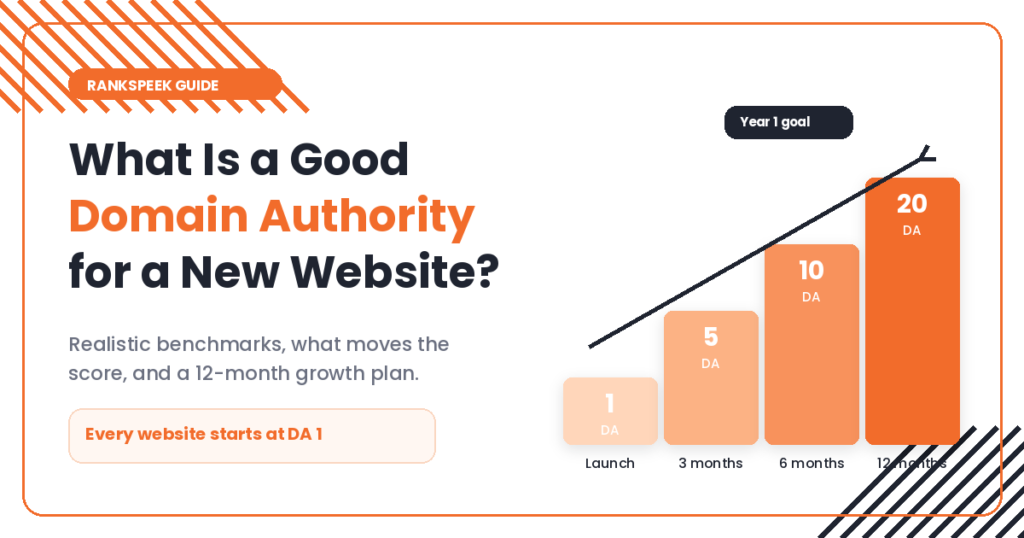
You launched your website, checked its Domain Authority, and saw a tiny number. Do not panic. Every site on the internet started at the bottom. So what counts as a good domain authority for a new website? The honest answer: lower than you think. In this guide, you will see realistic benchmarks by site age, learn what actually moves the score, and get a 12 month plan to grow it the right way.
New websites start at Domain Authority 1. Reaching 10 to 20 within the first year is a healthy result for most niches. A good domain authority is always relative, so compare your score with direct competitors instead of big brands. If similar sites sit at 25, then 25 is your target, not 70.
What Is Domain Authority, Exactly?
Domain Authority (DA) is a score from 1 to 100 created by Moz. It predicts how well a website can compete in search results. Ahrefs has a similar metric called Domain Rating (DR). Both work the same way: more quality backlinks, higher score.
One honest point before anything else. Google does not use DA or DR. They are third party metrics, not ranking factors. However, they remain useful as a thermometer. They measure the strength of your backlink profile, and backlinks do influence rankings. So treat the score as a progress tracker, not a grade from Google.
The scale is also logarithmic. In simple words, climbing from 10 to 20 is far easier than climbing from 40 to 50. Each step up costs more effort than the last one. New site owners often miss this, so they set unrealistic targets.
What Is a Good Domain Authority for a New Website?
Every new domain starts at DA 1. There are no shortcuts past that starting line. From there, realistic milestones look like this:
In the first three months, expect DA 1 to 5. Google barely knows you exist yet. Between three and six months, DA 5 to 10 is normal if you publish regularly. By the one year mark, DA 10 to 20 is a healthy result for most small websites. Consequently, anything above 20 in year one means you are doing very well.
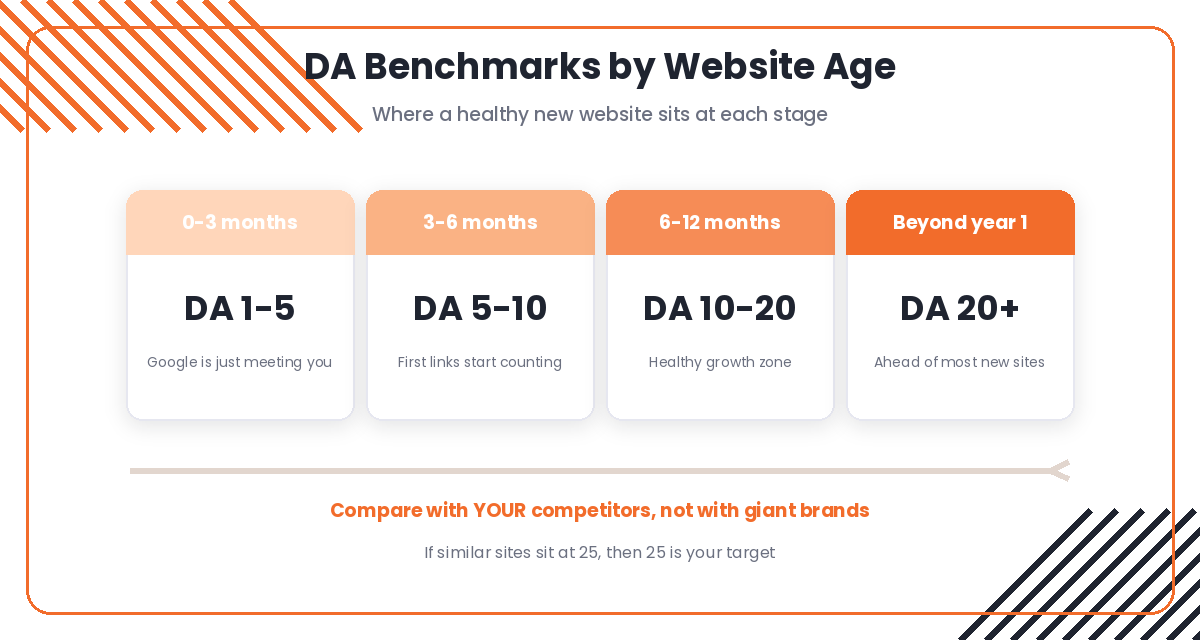
Want to know where you stand today? Check your score in seconds with our free DA PA DR Checker. Then check three or four competitors with the Bulk DA PA Checker. Those numbers matter more than any universal benchmark.
Why a Good Domain Authority Is Always Relative
Here is the trap most beginners fall into. They compare their new site with giant brands and feel defeated. That comparison is meaningless. A local plumber does not compete with Wikipedia. A niche blog does not compete with Amazon.
Instead, compare your score with the sites that actually rank for your target keywords. If they sit between 15 and 25, then 20 makes you competitive. Meanwhile, a score of 35 in one niche can be weaker than 15 in another. Context decides everything. Therefore, your real goal is simple: match or beat the sites directly above you in the results.
What Actually Moves the Score
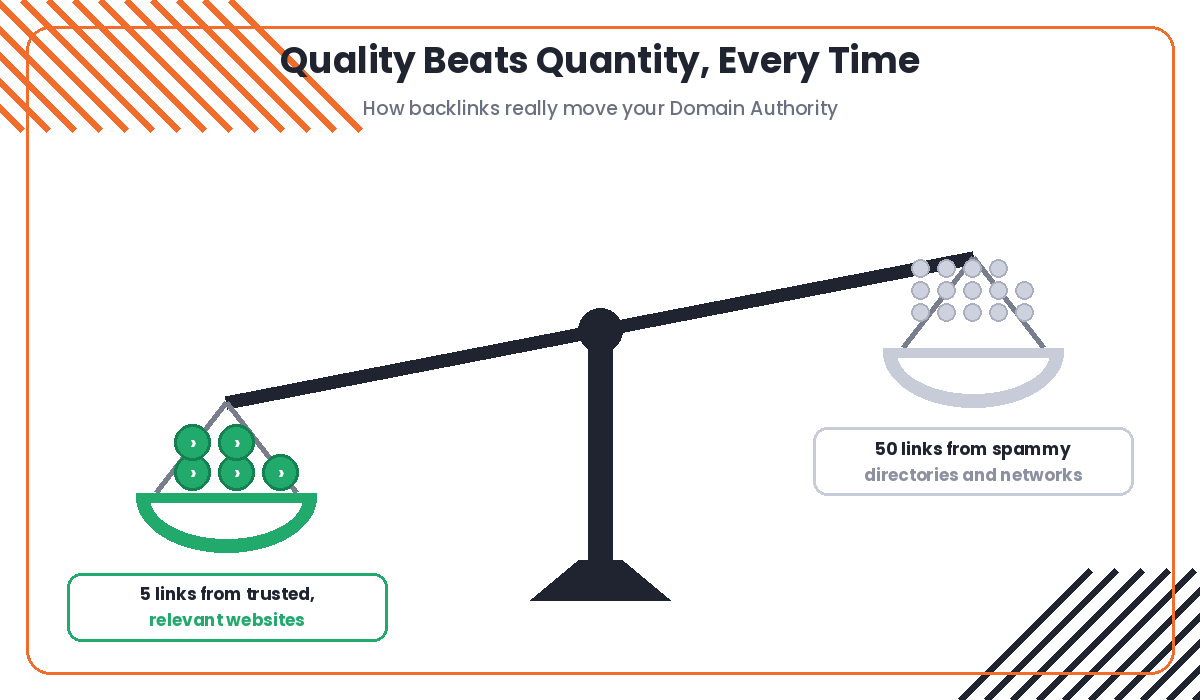
Backlinks drive the score, but quality beats quantity every time. One editorial link from a respected industry site outweighs fifty directory submissions. Link diversity matters too. Ten links from ten different trusted domains beat thirty links from one domain.
Age plays a supporting role, because links accumulate over time. Content quality works indirectly. Better pages attract better links, and they keep visitors around longer. Technical health supports everything else. A fast, crawlable site makes every link count. You can review who links to you anytime with our free Backlink Checker.
How to Grow From DA 1: A 12-Month Plan
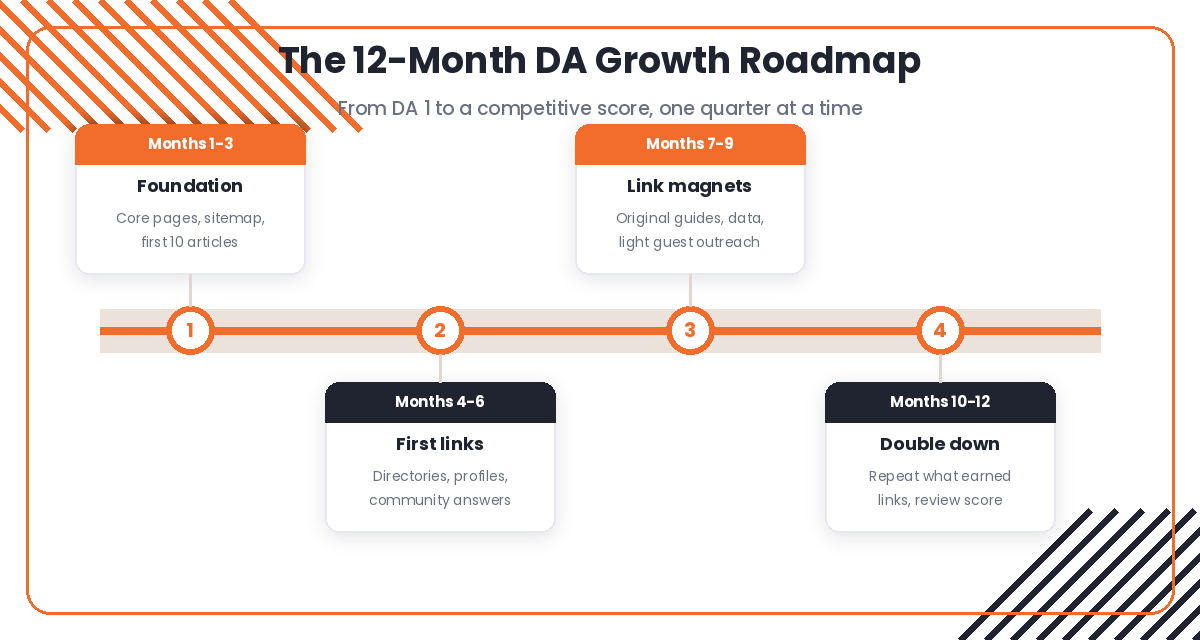
Months one to three: build your foundation. Publish your core pages, set up Google Search Console, and submit your sitemap. Then create your first ten helpful articles. Additionally, run your site through our SEO Checker to fix technical basics early.
Months four to six: earn your first links. List your business in relevant directories. Create profiles on major platforms with links back to your site. Also, answer questions in communities where your expertise fits naturally.
Months seven to nine: publish content worth citing. Original data, detailed guides, and honest comparisons attract links on their own. Meanwhile, start light outreach. Offer guest posts to related blogs in your niche.
Months ten to twelve: review and double down. Check which pages earned links and which did not. Consequently, you learn what your niche wants to cite. Make more of that. By month twelve, DA 10 to 20 is well within reach.
Mistakes That Keep New Sites Stuck at Low DA
The biggest mistake is buying cheap backlinks. Five dollar link packages come from spam networks. They inflate nothing and they raise your spam score instead. If you already made this mistake, read our guide on how to reduce spam score for the cleanup process.
The second mistake is checking the score daily. DA updates slowly, so daily checks only create anxiety. Monthly checks are enough. The third mistake is chasing the metric instead of the business. Traffic, leads, and rankings pay the bills. The score just describes them. Google’s own Search Essentials guidelines say it clearly: helpful content and genuine links win. Everything else is decoration.
What Changed for Domain Authority in 2026
Brand mentions matter more than ever this year. AI Overviews and answer engines cite sources they recognize and trust. As a result, a new website with a clear brand, consistent social profiles, and genuine mentions builds authority faster than an anonymous one. Your name showing up across the web has become part of the game.
Additionally, link spam detection got sharper in 2026. Purchased link packages get discounted faster than before. So the gap between earned links and bought links keeps widening. For a new website, this is actually good news. Patience and quality now beat budgets more often.
Frequently Asked Questions
Is DA 10 good for a new website?
Yes. Reaching DA 10 within your first six to twelve months shows real progress. Most brand new sites sit between 1 and 5 for months. So a 10 means your links and content are working.
How long does it take to reach DA 20?
For most small websites, twelve to eighteen months of consistent work. Regular publishing plus steady, genuine link earning gets you there. However, competitive niches can take longer.
Does a good domain authority guarantee rankings?
No. A page from a lower DA site can outrank a higher one with better content. DA describes potential, not results. Relevance, search intent, and content quality decide each individual keyword.
Why did my DA drop suddenly?
Usually it reflects an index update, not a real loss. The metric recalculates when its link data refreshes. Also, if competitors gained links faster than you, your relative score can dip. Check monthly trends instead of single drops.
What is the difference between DA, PA, and DR?
DA (Moz) scores your whole domain. PA scores a single page. DR (Ahrefs) is a domain score like DA but from different data. Our DA PA DR Checker shows all three together for any site, free.
A good domain authority for a new website is simply one that grows. Check your starting point with the free DA PA DR Checker, benchmark your competitors, and follow the 12 month plan above. Then explore all 17 free tools on RanksPeek to keep every part of your SEO moving.
The RanksPeek Team builds free SEO tools that help website owners check authority, backlinks, keywords, speed and more, with no signup needed. Explore all 17 free tools →